Which Camera Is More Accurate: Front Camera vs. Back Camera?
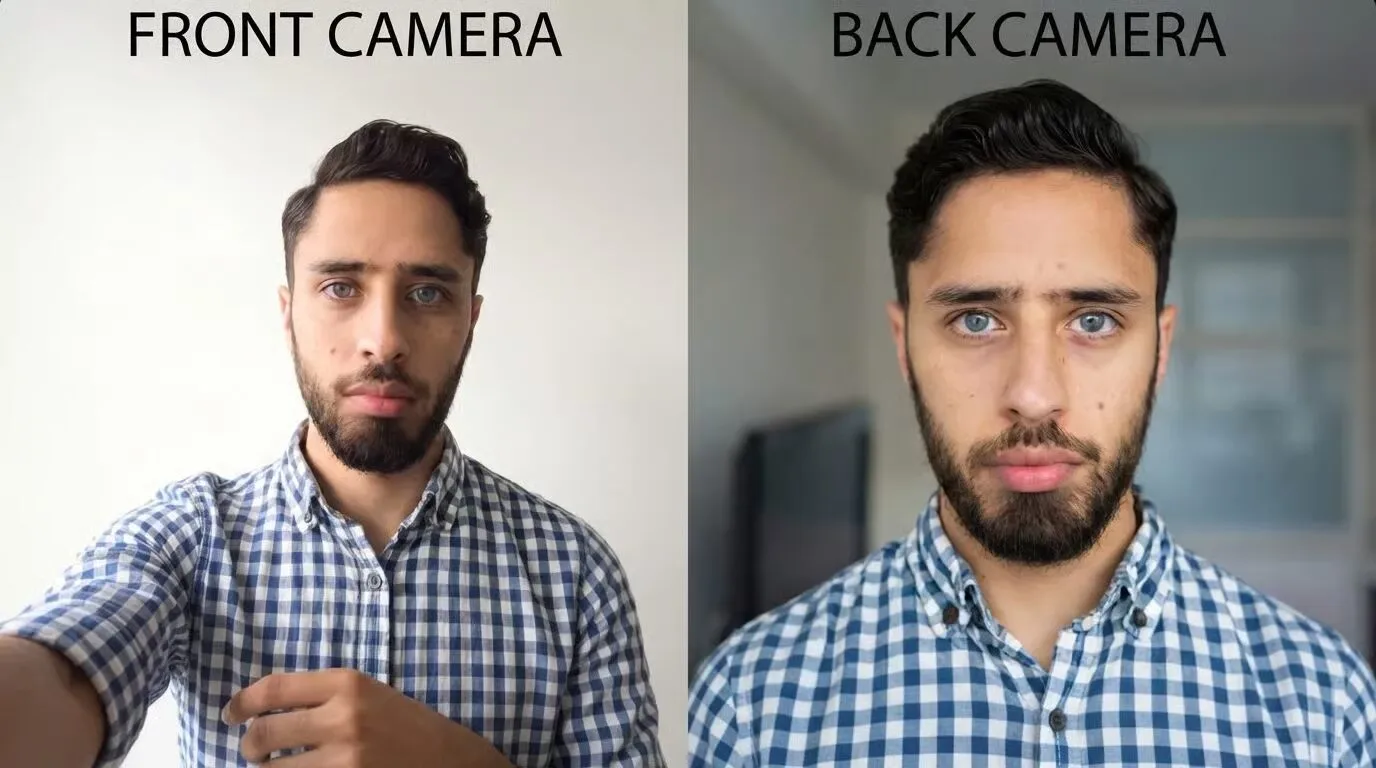
You raise the phone, tap the shutter, and cringe. The face on the screen looks nothing like the person you saw in the bathroom mirror ten minutes ago. You flip to the back camera, snap again, and somehow it feels like a third stranger. Same face, same lighting, same device — three different “yous.”
The short answer surprises most people. The back (rear) camera captures a more optically accurate image of your face — the version other people actually see when you walk into a room. The front (selfie) camera only feels more accurate because your brain has spent a lifetime memorizing your mirror reflection. Once you understand sensor size, focal length, subject distance, and a psychological quirk called the mere-exposure effect, the whole debate finally makes sense.
This deep-dive explains exactly which camera wins the accuracy fight, why selfies “feel right” but rear-camera photos of you often don’t, and how to shoot a self-photo that finally looks like the real you. Along the way, we’ll unpack lens physics, computational photography, plastic surgery research, and pro-level tricks that flatter without lying.
TL;DR — The 30-Second Answer
- Objective accuracy winner: The back camera. It uses a bigger sensor, sharper optics, and captures you un-mirrored — exactly the way other humans see you across a room.
- Perceived accuracy winner: The front camera. Its mirrored preview matches the flipped face you’ve studied in every mirror you’ve ever used.
- The real villain behind “selfie face”: Not the lens itself, but shooting distance. A Rutgers University study published in JAMA Facial Plastic Surgery in 2018 found that photos taken from 12 inches away make the nose appear roughly 30% wider in men and 29% wider in women compared with a portrait from 5 feet away.
- The fix: Use the rear camera, step back to 4–6 feet, shoot at eye level in soft light, and turn off default beauty filters. Neither camera is a perfect mirror of reality — but one is objective, and the other is emotional.
Two Cameras, Two Very Different “Yous”
Every modern smartphone hides two entirely different imaging systems inside the same slab of aluminium and glass. On one side sits the front (selfie) camera, engineered for arm-length shots and video calls. On the other sits the main rear camera array, engineered to compete with dedicated point-and-shoot bodies — and, increasingly, with entry-level mirrorless cameras.
These two systems don’t just point in opposite directions — they capture reality in opposite ways. The front camera prioritises convenience, smoothing, and speed. The rear camera prioritises detail, dynamic range, and truthful colour. Once you understand that fundamental split in engineering intent, the front-vs-back debate stops being about vanity and starts being about physics. The same tension powers our related deep-dive on mirror vs camera accuracy.
Manufacturers pour the vast majority of their camera R&D budgets into the rear module. That’s why the back lens almost always outperforms the selfie shooter in sharpness, dynamic range, and colour science. For a look at how quickly the hardware has evolved on the rear side, our overview of the evolution of photography shows how sensors and lenses have improved across decades — and why today’s flagship rear cameras finally rival dedicated compacts.
The Core Difference: What Each Camera Actually Does
Front and rear smartphone cameras look similar on a spec sheet, but they serve completely different purposes.
The front camera exists to help you frame yourself. It sits behind a tiny cutout or under-display window, uses a small sensor, and typically ships with a wide-angle lens (roughly 22–26 mm equivalent) so your whole head fits in the frame at arm’s length. Its autofocus is often fixed or slow, and its preview is mirrored by default so it matches the reflection your brain expects.
The back camera is engineered for everything else — landscapes, food, pets, weddings, product shots, and yes, portraits. Manufacturers pack it with larger sensors, multiple focal lengths (ultra-wide, main, and telephoto), phase-detect autofocus, optical image stabilisation, and stronger image processing pipelines. Its output is un-mirrored — a stranger’s-eye view of whatever the lens sees.
Key functional differences look like this:
- Field of view: front cameras are wide-angle by necessity; rear main cameras sit around 24–28 mm on the wide, 26–30 mm on the main, and 50–120+ mm on the telephoto lenses of most flagships.
- Autofocus: rear cameras use phase-detect or laser AF; many front cameras still rely on fixed focus tuned for arm-length distance.
- Mirroring: the selfie preview is flipped left-to-right by default; the rear feed never is.
- Processing pipeline: selfie photos usually pass through heavier skin-smoothing, teeth-whitening, and eye-brightening algorithms before you ever see them.
What Actually Distorts Your Face: Focal Length or Distance?
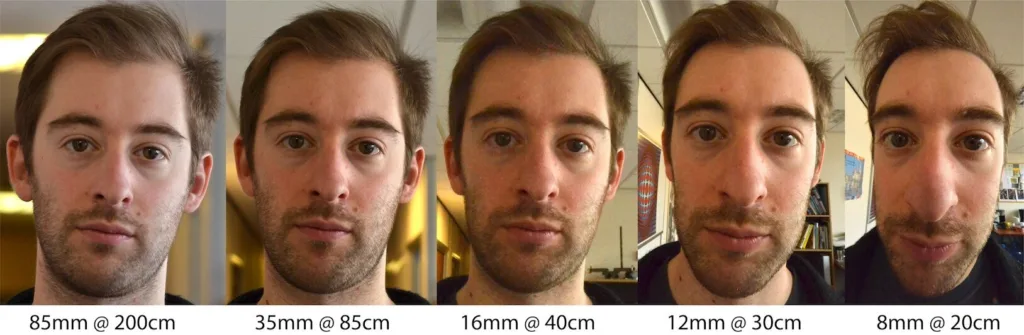
Here comes the physics moment that ends most family arguments about selfies. Every photographer eventually learns a counter-intuitive truth: focal length itself does not distort faces — distance does. A wide-angle lens simply lets you get closer before the frame fills up, and it is that closeness that stretches your nose and shrinks your ears.
When you hold your phone at arm’s length, your nose sits maybe 12 inches from the sensor, but your ears sit almost 18 inches away. That 6-inch gap is a big percentage of the total distance, so anything closer to the lens looks disproportionately larger.
The Rutgers 30% Nose Study
In one of the most cited papers on this topic, Dr. Boris Paskhover of Rutgers New Jersey Medical School and his collaborators built a 3D mathematical model of the human face and used it to measure how camera distance changes nasal proportions. Their paper, published in JAMA Facial Plastic Surgery in March 2018, found that at a typical selfie distance of 12 inches, the nasal base appeared approximately 30% wider in men and 29% wider in women compared with a portrait taken from 5 feet away. The nasal tip alone appeared roughly 7% wider. Paskhover explicitly designed the study to give plastic surgeons a way to counsel patients who were bringing selfies into consultations and asking for nose jobs.
Rhinoplasty consultations climbed so sharply during the selfie boom that surgeons began coining a new term for it, which we’ll cover in the computational-photography section below.
Why Focal Length Still Matters — a Little
Photographers call 50–85 mm the sweet spot for flattering, life-like portraits. Digital Photography School and most portrait pros agree that 85 mm is often the best all-round choice for headshots because it “delivers beautiful, tight images from a reasonable distance.” A phone selfie lens sits around 23–26 mm equivalent, which forces you to shoot close, which is where the distortion enters through the back door.
Quick reality check:
- 24 mm selfie at 12 inches → wider nose, larger forehead, smaller ears
- 50 mm portrait at ~4 feet → natural proportions
- 85 mm portrait at ~6 feet → slightly compressed features, extremely flattering
If your driver’s licence photo — shot from about 6 feet away — looks more like the “real you” than any bathroom selfie, this is why. The wider the 4:3 aspect ratio selfie frame, the more edge distortion you invite.
The Mirror Flip Mystery: Why Selfies “Feel Right”
Here’s the twist that trips up almost everyone: you have literally never seen your own face the way the rest of the world sees it. Every mirror on the planet flips your reflection left-to-right — and so does your phone’s selfie preview by default.
Human faces are never perfectly symmetrical. One eye sits slightly higher, one nostril flares wider, one eyebrow arches more, one corner of the mouth lifts sooner. Because you’ve studied only the reversed version of those asymmetries your entire life, the un-flipped rear-camera version genuinely does look “off.” Psychologists call this the mere-exposure effect, first formally described by Robert Zajonc in his 1968 paper “Attitudinal Effects of Mere Exposure” — humans prefer things they see often, purely because familiarity feels like safety.
A peer-reviewed 2023 study on PubMed Central (“Perception of frontal facial images compared with their mirror images”) tested 198 participants and confirmed the pattern in modern smartphone conditions. 59.1% preferred the original, un-mirrored frontal photo of themselves at rest, while 56.6% preferred the mirrored version of their own selfie at rest. The takeaway isn’t a simple “everyone prefers mirror images” — it’s that preference shifts with distance and framing. Close-up selfies benefit from mirroring because that matches your bathroom-mirror memory; a proper frontal photo taken at portrait distance already looks correct to most people even un-flipped.
Want to test this at home in 60 seconds? Take a mirror selfie, then take the same shot with the rear camera, then hold the rear photo up to a mirror. The mirrored rear photo will look identical to your reflection — proof that the “weirdness” was orientation, not physics.
Translation: the rear camera shows the version of you that your friends, strangers, cashiers, and dates carry around in their heads. The selfie camera shows the version that lives in yours. Both are technically correct — you’re just looking at different reference points.
Hardware Deep Dive: Sensors, Lenses & Processing
Look at any teardown of a flagship phone and the size difference between the two camera modules jumps out immediately. Rear main sensors on premium phones now sit in the 1/1.5″ to 1″ range, with the Xiaomi 14 Ultra shipping a full 1-inch Sony LYT-900 sensor — the same class used in some point-and-shoot cameras. Front sensors, by contrast, typically top out around 1/3.6″ to 1/2.7″. That’s roughly a third of the light-gathering surface area.
Sensor size matters more than megapixel count. A larger sensor:
- Gathers more light per pixel, which reduces noise in dim rooms
- Delivers wider dynamic range, holding detail in bright windows and shadowed corners at the same time
- Produces gentler natural bokeh because the depth of field is genuinely shallower rather than software-faked
- Records more accurate colour because bigger photosites sample the scene with less signal amplification
Lens Quality
Rear lens stacks often include 6–8 aspherical elements with coated glass to minimise flaring. Front lenses commonly use 3–4 elements to save space behind the display or under a punch-hole cutout. The visible result: less edge sharpness, more chromatic aberration, and softer overall rendering in selfies — even before any AI touches the image.
Autofocus & Stabilisation
Rear cameras on flagships include OIS (optical image stabilisation) plus phase-detect or laser autofocus. Front cameras usually rely on fixed focus or slower contrast-detection AF, which is one reason selfies of moving subjects (kids, pets, yourself laughing) so often come out slightly soft.
Resolution Isn’t Everything
A 50 MP front camera can still lose to a 12 MP rear camera because pixel binning, sensor area, and lens quality matter far more than raw megapixels. For a primer on how resolution actually translates into visible detail, see our piece on 4K resolution — and for a look at why big-sensor cameras still rule real image quality, our mirrorless camera guide walks through the physics.
Computational Photography: The Silent Editor Inside Your Phone
Modern smartphones no longer take single photos. From the moment you open the camera app, they’re firing a burst of frames, aligning them, blending the best data, brightening faces, warming skin tones, and delivering a “photo” that never technically existed in one moment. Everything you see on screen is a composite.
Selfie cameras lean on this pipeline hardest. As BBC Future reported in early 2026, flagship phones now use AI models to hallucinate detail — sharper eyelashes, cleaner pores, brighter irises — that the sensor never actually captured. Research summarised in the same piece suggests these AI-edited images can subtly plant false memories about how we and our surroundings really looked.
Common invisible edits applied to selfies before you ever see them include:
- HDR stacking to balance shadows and highlights
- Automatic skin smoothing and blemish reduction (Samsung, Huawei, Google Pixel, Xiaomi)
- AI portrait relighting for even face brightness
- Face-warp correction that reshapes wide-angle edges
- Subtle jawline slimming, eye enlargement, and teeth whitening on some Chinese OEM defaults
- Warm skin-tone shifts and aggressive noise reduction that erases natural pore detail
Apple famously landed in hot water in September 2018 over “Beautygate,” when iPhone XS owners noticed the front camera was auto-smoothing skin without a visible toggle. Apple later addressed the noise-reduction behaviour with a software update, tracing it to how the new Smart HDR pipeline was interacting with the front sensor. The episode proved a bigger point: your selfie is edited before you ever see it.
“Snapchat Dysmorphia”
The same period gave the medical community a new phrase. In an August 2018 editorial in JAMA Facial Plastic Surgery, Boston University researchers picked up the term “Snapchat dysmorphia” — originally coined by British cosmetic doctor Dr. Tijion Esho — to describe patients bringing filtered selfies into consultations and asking surgeons to make them look like the algorithm’s version of themselves. The takeaway from those clinicians is the same as Paskhover’s Rutgers finding: the “you” your front camera shows is not the “you” that exists in three-dimensional space.
Side-by-Side: Front vs Back Camera at a Glance
| Feature | Front (Selfie) Camera | Back (Rear) Camera |
|---|---|---|
| Purpose | Selfies, video calls, vlogging | Everything else — including proper portraits |
| Typical focal length (equiv.) | 22–26 mm (wide) | 24 mm main + 13 mm ultra-wide + 50–240 mm tele |
| Sensor size (flagship) | ~1/3.6″ – 1/2.7″ | ~1/1.5″ up to 1″ |
| Megapixels | 10–50 MP | 12–200 MP |
| Autofocus | Fixed or basic contrast AF | Phase-detect + laser + OIS |
| Beauty filter default | Often ON | Rarely ON |
| Mirrored preview | Yes | No |
| Best distance to subject | 12–18 inches | 3–8 feet |
| Optical accuracy to real life | Lower | Higher |
| “Feels like you” | Higher (mirror familiarity) | Lower initially |
So Which One Is More Accurate? The Verdict
If “accuracy” means physical, optical truth — how you actually appear to other humans standing across a room — the back camera wins, hands down. It has the bigger sensor, the sharper glass, the longer available focal lengths, and it delivers an un-mirrored image. That’s the version of you that walks into rooms and shakes hands.
If “accuracy” means the version of you that lives in your own head — the reflection you’ve studied every morning of your life — the front camera wins. It flips the frame to match your mirror memory, applies subtle flattering processing, and delivers a face your brain instantly recognises.
The most honest description is this:
- The back camera shows the objective you.
- The front camera shows the you that you recognise.
Neither is a lie. They capture different truths. Professional headshots, passport photos, driver’s licences, and portrait portfolios all rely on the rear-camera model of reality — shot from several feet away with an 85 mm-equivalent lens on a dedicated body, never with a phone at arm’s length. If you’re curious how modern lens design impacts everyday portrait shots, our breakdown of the best Nikon lenses shows what “distortion-free” really looks like on a proper portrait rig.
Ready to see the difference expert retouching makes on your portraits?
Test our premium Beauty Retouching Services today with a free, no-obligation trial.
Practical Tips: How to Get the Most Accurate Self-Photo
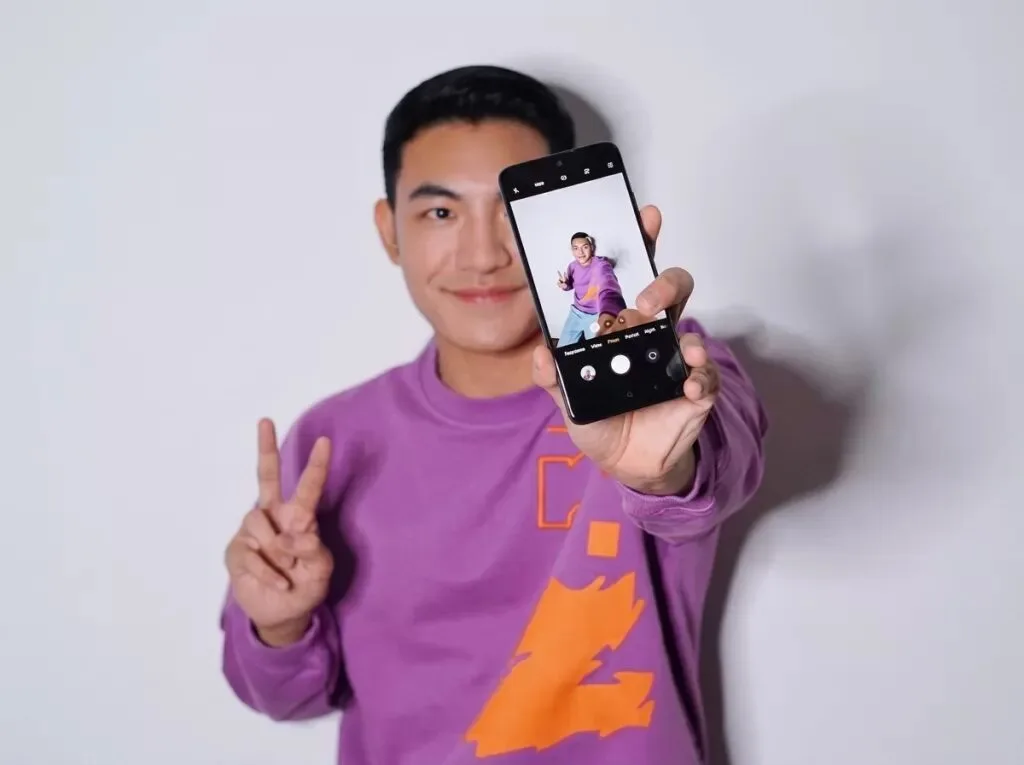
You can’t change perspective physics, but you can outsmart it with a few habits.
- Step back. Use a tripod, timer, selfie stick, or a friend with the rear camera to shoot from 4–6 feet away. Even 18–24 inches of extra distance dramatically reduces facial exaggeration.
- Zoom in to 2× or 3×. Most modern flagships (iPhone 15 Pro and up, Galaxy S24 series, Pixel 8 Pro and up) engage the telephoto lens at 2× or 3×, mimicking the classic 50–85 mm portrait feel without adding real distortion.
- Shoot at eye level or slightly above. Cameras below your chin exaggerate a double chin and flare the nostrils; angles from just above eye line slim the jaw and enlarge the eyes.
- Choose soft, even light. North-facing window light beats overhead ceiling bulbs almost every time. Golden hour outdoors is even better.
- Turn off Beauty Mode. On iPhone: Settings → Camera → toggle off any smoothing. On Samsung, Xiaomi, or Honor: open Camera → Face Retouching → set to 0.
- Un-mirror the front camera if you must use it. iOS 14+ and most Androids let you disable “Mirror Front Camera” in Settings so the saved photo matches what others see.
- Use the 3-second timer to relax your face muscles before the shutter fires. A burst of 5–10 frames beats hunting for one perfect exposure.
- Shoot in RAW where available (iPhone Pro, most flagship Androids) so skin tones and white balance can be corrected later.
For a broader skill-boost, our roundup of photography tips walks through composition, light, and posing habits that make any camera flatter you.
💡 Have a great shot but need clean edges around your face or product? Get precision clipping paths hand-drawn by our expert editors.
Color Accuracy, Skin Tone & White Balance
Even after you nail the framing, colour science can still betray reality. Front cameras tend to push warmer, softer tones with slightly higher contrast to make skin “pop” against dim indoor backgrounds. Rear cameras stay closer to neutral because they expect to shoot a wider variety of subjects — sunsets, foods, products, and skin all at once.
- Front cameras usually warm skin tones and add glow.
- Back cameras deliver more neutral colour science, closer to Adobe RGB or DCI-P3 standards.
- Mixed lighting (window daylight + tungsten bulb + LED screen) confuses auto white balance on both cameras.
- HDR can flatten skin texture, robbing you of natural micro-detail.
When accurate colour really matters — portfolio shots, e-commerce product photos, professional headshots — shoot near a big window at mid-morning, let the phone auto-adjust, then verify on a calibrated screen. Editors who correct colour drift for a living rely on tools we cover in our photo retouching software guide, and if you deal with hue-sensitive work, our tutorial on how to change an object’s colour in Photoshop is a useful follow-up.
Want your images to look professionally edited, not over-processed?
Achieve natural, high-end perfection with our skilled Photo Retouching Service
What Professional Photographers Do Differently
Ask any working portrait photographer why their clients look “so much better” in the studio and the answer is rarely “we edited a lot.” It usually comes down to three things pros control that phones cannot.
- Distance: they stand 6–10 feet from the subject and zoom in with a longer lens rather than stepping in with a wide.
- Focal length: they shoot at 85 mm, 105 mm, or 135 mm — never wider than 50 mm for a tight headshot.
- Lighting: they shape the light before shaping the person, using diffusers, reflectors, softboxes, and bounce cards to lift shadows and soften highlights.
The smartphone rear camera can approximate two of those three: distance (by stepping back) and focal length (by using the 2× or 3× telephoto lens). That’s why a rear-camera portrait from six feet away in soft window light behaves like real portrait photography. The front camera, tethered to arm’s length and a fixed ultra-wide, simply cannot.
You can replicate a lot of the pro playbook at home with a $30 phone tripod, a bright window, and a sheet of white foam board as a reflector. Even a basic mirrorless setup — check our best mirrorless cameras roundup — will transform your self-portrait game overnight.
Front Camera vs Back Camera for Different Use Cases
Not every situation demands the “most accurate” camera. Sometimes context wins.
- Casual selfies for social media → Front camera. Speed and framing matter more than optical truth.
- Professional headshots and LinkedIn photos → Back camera on a tripod, 2× zoom, remote shutter.
- Group photos → Back camera. The wider dynamic range and better edge sharpness handle multiple faces without stretching anyone at the edge.
- Video calls and Zoom meetings → Front camera. Framing yourself live requires a mirrored preview.
- Dating app profile pics → Back camera, taken by a friend. This is how they’ll see you IRL.
- Passport, visa, and ID photos → Back camera at 3–5 feet, straight-on, no beauty filter.
- Low-light shots → Back camera wins on sensor size and noise control.
- E-commerce product photography → Back camera by a mile — and often benefits from a professional clipping path treatment afterward.
Want to boost your online sales with better product photography?
High-quality images increase conversions by up to 40%. Let us help you get there. See our editing services
Camera Angles That Change How “Real” You Look
Angle changes physics. Even the same camera produces very different results depending on tilt and height.
- Below-chin angle — enlarges the jawline, shrinks the forehead, flares the nostrils, and often adds a double chin. Universally the least flattering.
- Straight-on eye level — the most anatomically accurate view, used for IDs and formal headshots.
- Slightly above eye level — the classic “Instagram angle.” Slims the jaw and enlarges the eyes. Not a lie, just a natural corrective.
- Extreme close-up — worst possible perspective for accuracy; your nose becomes the star.
- 3/4 profile — flatters most face shapes, hides asymmetry, and is often used by portrait pros.
Pro tip: hold the phone at eye level, then raise it about two inches. That tiny shift is the single most flattering habit you can build into your daily photos, regardless of which camera you choose. If you want to understand how your eyes actually perceive these shifts, our deep-dive on human eye resolution explains how your brain fills in gaps a camera never can.
Common Myths About Front vs Back Cameras
There’s a lot of misinformation floating around TikTok and Reddit. Let’s clean it up.
- ❌ “The back camera makes me look ugly on purpose.” No — it just doesn’t flatter you with a mirror flip or auto-smoothing.
- ❌ “Higher megapixels equal more accuracy.” Not true. Sensor size, pixel size, lens quality, and processing matter far more than raw megapixel count.
- ❌ “iPhone selfies never apply beauty filters.” Historically inaccurate — the 2018 “Beautygate” episode proved otherwise, and modern computational pipelines still touch every selfie.
- ❌ “Mirrors show the real you.” Mirrors flip you. Neither mirror nor camera is 100% accurate.
- ❌ “Front cameras have worse resolution.” Some now hit 50 MP. The real issue is optics and distance, not pixel count.
- ❌ “Turning off HDR fixes distortion.” HDR affects tone and highlights, not perspective. Distance is the only real cure.
- ❌ “All phone cameras behave the same way.” False. iPhones lean neutral, Samsung leans saturated, Pixel leans contrasty and shadow-rich, and many Chinese OEMs lean heavily on face beautification by default.
Pro Tips to Make Any Camera More Flattering (Without Lying)
You don’t need surgery, filters, or expensive gear to look like yourself. You need light, distance, and one honest angle.
- Face your light source. Turn toward a window, not away from it.
- Push your forehead slightly forward and drop the chin a hair. This sharpens jawline definition without any editing.
- Relax your face with a slight exhale before the shutter clicks.
- Smile with your eyes — the so-called “Duchenne smile” reads as genuinely more attractive than a mouth-only smile.
- Wear a colour that contrasts with your skin tone.
- Keep the camera at or just above eye level.
- Take at least 10 frames and delete freely — even pros toss 90% of what they shoot.
- Use the 2× or 3× rear zoom for headshots — it approximates an 85 mm lens without adding real distortion.
- Never shoot straight up at your own face unless drama is the goal.
If you plan to print any of these shots, our roundup on standard photo sizes helps you frame correctly the first time.
Computational Beauty vs Photographic Truth
Ultimately, the front-vs-back debate is a proxy for a bigger question: do you want a pleasing photo or a true photo? The two are no longer the same thing. AI pipelines on modern phones now generate detail the sensor never recorded, adjust skin tone across the whole face, and smooth micro-expressions you cannot even see happening.
That isn’t necessarily bad. Photography has always involved choices — lighting, angle, retouching, printing. But it does mean both cameras deliver interpreted images, not raw truth. The rear camera simply interprets less aggressively.
Ready to make every image look premium? Our fast, affordable color correction service fixes skin tones, product colors, and mixed-light photos in one pass.
The Bigger Picture: Cameras Never Fully Capture Reality
Here’s the honest truth no filter will admit: all photos are compressions of reality. And, they flatten 3D depth into 2D. They freeze a single moment out of continuous motion. They swap your two-eyed stereo vision for a one-eyed monocular one, sampled through a small aperture, filtered by a colour-filter array, warped by curved glass.
Human vision, by contrast, is binocular, wraps around nearly 180 degrees, and refreshes continuously. If frame rate fascinates you, our post on how many FPS the eye can see explains just how different biological vision is from any sensor ever built.
So when we ask “which camera is more accurate,” the honest answer is: neither perfectly, but the rear camera is significantly closer to the geometrical truth of your face. That’s the version other people carry around in their heads when they think of you. Whether you like that version is a separate — and much more personal — conversation.
Quick-Reference Checklist for the Most Accurate Self-Photo
- ✅ Use the rear (back) camera, not the front
- ✅ Ask a friend or use a tripod at 4–6 feet
- ✅ Set focal length to 2× or 3× zoom if your phone has a telephoto lens
- ✅ Keep the camera at eye level or slightly above
- ✅ Shoot in soft, even light — window preferred
- ✅ Turn off Beauty Mode and heavy HDR
- ✅ Un-mirror the selfie preview if you must use the front camera
- ✅ Shoot in RAW or highest JPEG quality
- ✅ Take 10+ frames and pick the most natural expression
Ready to transform your raw photos into professional assets?
Get a custom, no-obligation quote tailored to your specific volume and needs. Explore Clipping Expert Asia
FAQs: Front Camera vs Back Camera Accuracy
1. Is the front or back camera more accurate to real life?
The back camera is more optically accurate because it uses better hardware — larger sensor, sharper lens, longer focal length — and captures your face un-mirrored, exactly the way other people see you. The front camera feels more familiar because it mirrors the preview to match your reflection.
2. Why do I look “ugly” in the back camera but fine in the front?
You aren’t uglier in the back camera — you’re just seeing an un-flipped version of your own face for the first time, combined with a less flattering focal length or angle. Once your brain adjusts to seeing your natural asymmetry the way strangers see it, the rear-camera version stops looking wrong.
3. Why does my nose look bigger in selfies?
Because the phone sits about 12 inches from your face when you take a selfie, your nose is proportionally much closer to the lens than your ears. A 2018 Rutgers study by Dr. Boris Paskhover, published in JAMA Facial Plastic Surgery, found this exaggerates nasal width by roughly 30% in men and 29% in women compared with a portrait taken from 5 feet away.
4. Do people see me as I appear in the mirror or in photos?
People see you closer to how the back-camera photo looks — un-mirrored. Your mirror is a flipped version of you that only you have grown used to.
5. Does iPhone’s “Mirror Front Camera” toggle change accuracy?
It only changes whether the final saved image gets flipped to match your live preview. The pixel data is the same. Turning it OFF gives you the un-mirrored “what others see” version.
6. Are back-camera selfies really higher quality?
In almost every case, yes. The rear camera has a larger sensor, better optics, phase-detect autofocus, and a longer effective focal length. The only real trade-off is that you can’t see yourself while shooting — a problem easily solved with a tripod, a timer, or a mirror-preview app.
7. Which focal length looks most like a real human face?
Roughly 85–135 mm in full-frame equivalent. That range compresses features naturally and matches what human vision expects. Most flagship phones approximate this with a 2× or 3× telephoto lens, which is why zooming in a little tends to flatter more than shooting at 1×.
8. Why do I look better in the mirror than in any photo?
Familiarity plus lighting. Mirrors are usually installed in well-lit bathrooms, they reverse the face you already know, and they show you in motion. Photos freeze one micro-expression from one angle in imperfect light. Both are true — just differently.
9. Can editing fix camera distortion?
Partially. Perspective and lens-distortion sliders in tools like Photoshop and Lightroom can undo some wide-angle stretching. Editing cannot rebuild information the small selfie sensor never captured, so reshoot with the rear camera whenever possible and then polish the results with the best photo retouching software available in 2026.
Final Thoughts: Trust the Physics, Not the Filter
The next time your reflection and your photo disagree, remember what’s actually happening. The front camera is a mirror plus a wide-angle lens plus a beauty algorithm. The back camera is a bigger sensor, a longer lens, and slightly less software interference. Both show you a version of yourself; only one shows the version that walks into rooms and shakes hands.
Neither is the “real you.” The real you is a moving, three-dimensional, subtly asymmetrical human who exists in a specific light at a specific moment. Cameras approximate. Mirrors flip. Filters lie a little on purpose. And your brain — the most powerful image processor in the room — filters everything through memory and mood.
Choose the camera that fits the purpose. Use the front camera for quick chats, TikToks, and video calls. Use the back camera when accuracy actually matters — headshots, portfolios, family portraits, and any photo you’ll still care about in five years. If you love the front-camera version, keep enjoying it. If you want the honest one, hand your phone to a friend, ask them to step 5 feet back, and shoot with the rear lens at 2× zoom in soft window light. That single frame will be closer to the truth than a thousand mirror glances.