50mm vs 85mm: Which Focal Length Is Actually Better for Portraits?
TL;DR — the short answer: For pure headshots, beauty, and fashion portraits where you want a flattering face and creamy background separation, the 85mm wins. If you shoot in small rooms, want environmental context, shoot weddings/events, or are buying your first prime lens on a budget, the 50mm is the smarter pick. On a crop-sensor (APS-C) camera, a 50mm already behaves like a 75–80mm portrait lens, so the whole debate shifts. Most working portrait photographers eventually own both — they do different jobs.
Walk into any camera store (or any photography forum) and say “I want to take better portraits,” and within five minutes someone will ask you the question: 50mm or 85mm?
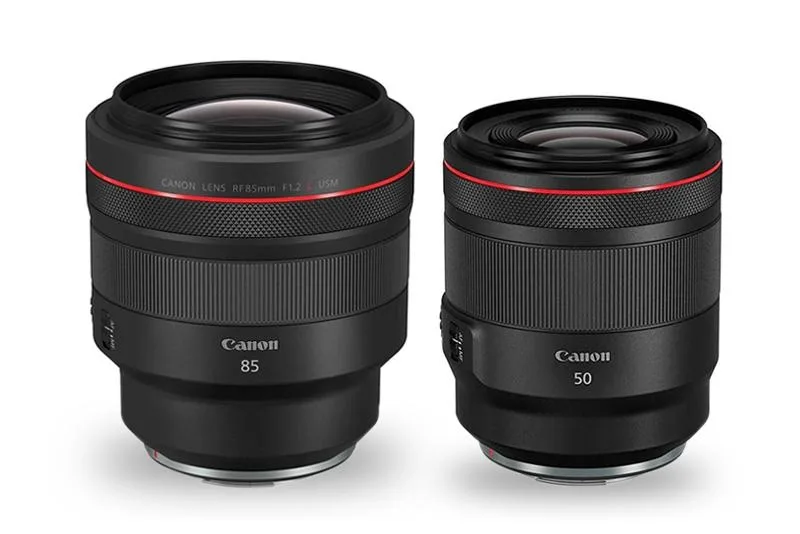
It’s the most argued-about pair of lenses in photography, and for good reason. Both are fast primes, both are sharp, both will give you that blurry-background look your clients love. But the 35-millimetre gap between them changes everything — how close you stand, how a face looks, how much of the room you see, and even how your subject feels in front of the camera.
After testing both in studios, living rooms, wedding receptions, and city streets — and reading through dozens of side-by-side comparisons from working photographers — I can tell you there is no universal “better” lens. There is only the better lens for the way you shoot. Let’s break it down so you can stop second-guessing and start taking pictures.
What Actually Changes Between 50mm and 85mm?
Before we talk about “look” or “feel,” let’s get the physics out of the way, because it explains why these lenses behave so differently.
On a full-frame camera, a 50mm lens captures roughly a 47° diagonal field of view. An 85mm narrows that down to about 29°. That doesn’t sound like much on paper, but in practice it means the 85mm sees less than half the scene. To frame a subject identically, you have to physically move back — a lot.
Here’s what that means for working distance (how far you stand from your subject) on full frame:
| Framing | 50mm working distance | 85mm working distance |
|---|---|---|
| Tight headshot / face | ~1.2 m (4 ft) | ~2.0 m (6.5 ft) |
| Head & shoulders | ~1.5 m (5 ft) | ~2.5 m (8 ft) |
| Waist-up / half body | ~2.5 m (8 ft) | ~4.0 m (13 ft) |
| Full body | ~4.0 m (13 ft) | ~6.5 m (21 ft) |
That extra distance is the single biggest practical difference. In a small bedroom or a cramped shop, an 85mm can literally force you to back up through a wall. Photographer Mujahid Ur Rehman ran into exactly this shooting a weaver in a tiny Bali shop — the 85mm couldn’t fit her torso in the frame, while the 50mm worked from multiple angles.
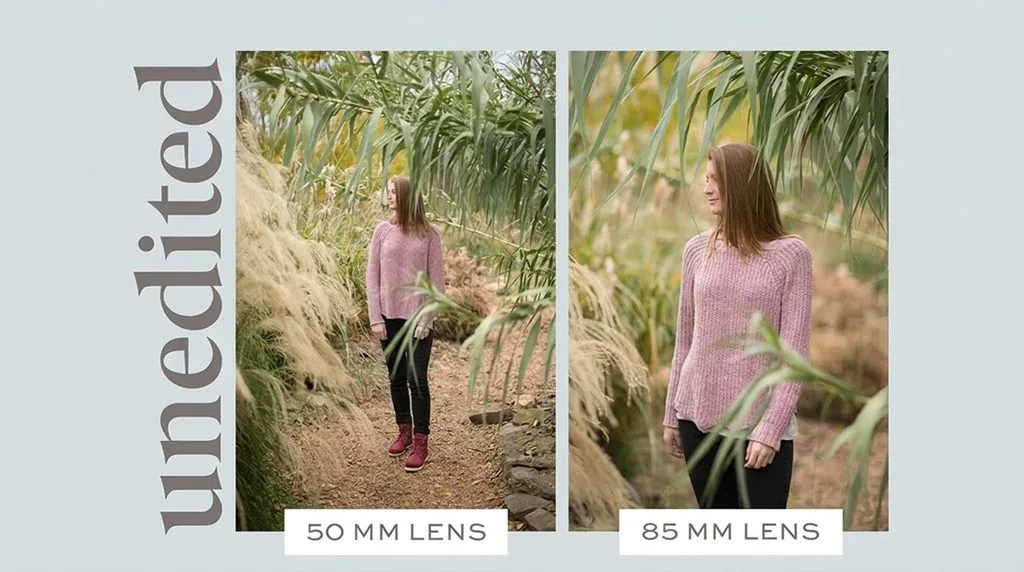
Why 85mm Flatter Faces — It’s the Distance, Not the Glass
Here’s the myth that won’t die: “85mm lenses compress faces and make them look thinner.” Actually, the lens itself doesn’t flatten anything. Your distance from the subject does. The lens only determines how far away you have to stand to get the framing you want.
When you shoot a face from very close up (say, under a metre), the nose — being closest to the camera — is proportionally much larger than the ears, which are further away. That’s perspective distortion: noses look bigger, foreheads bulge, chins narrow. It’s the same reason you look worse in photos taken at arm’s length than in a mirror vs camera comparison.
Because an 85mm forces you to stand ~2 metres away for a headshot instead of ~1.2 metres, the relative size difference between nose and ears shrinks. Features look more proportional, more like how people actually see each other in conversation. Canon’s own portrait-lens guide puts it plainly: a mid-telephoto from roughly 50–100mm gives “a natural compression that gives an attractive appearance to faces.”
A 50mm isn’t bad for faces — at 1.5 metres it’s still well within the flattering zone. But if you like tight close-ups and you’re shooting with a 50mm, you’ll be tempted to step in close, and that’s when features start to go wide. The 85mm makes flattering distance almost automatic.
Quick tip: Whatever lens you use, if a face looks slightly wide, take one step back and crop slightly in post. Two feet of distance does more for facial proportions than any retouching brush.
Bokeh and Background Separation: 85mm Pulls Ahead
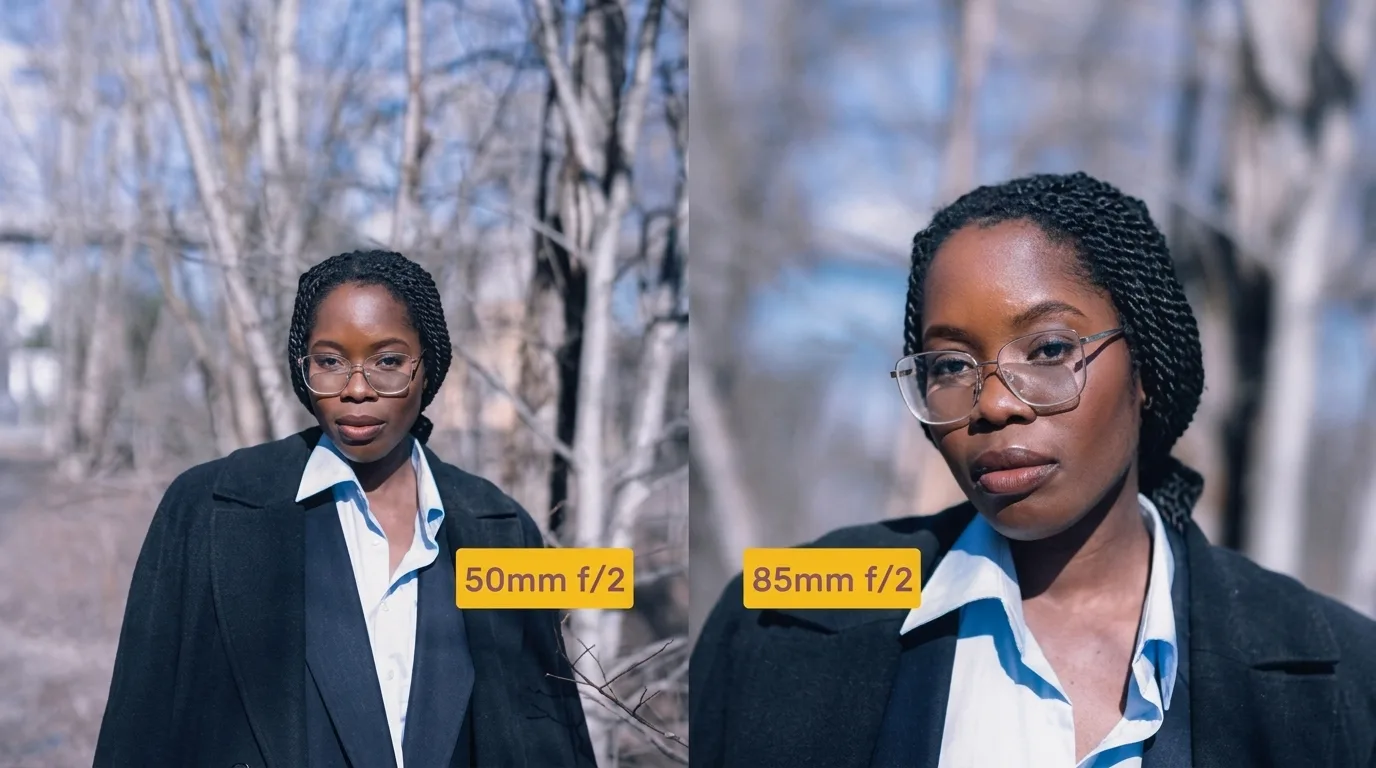
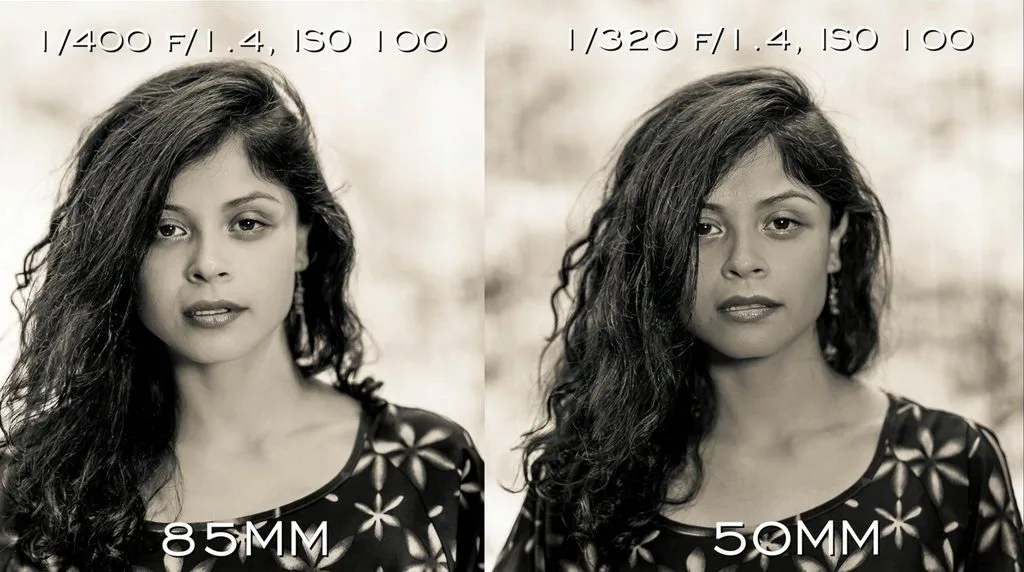
This is where the 85mm earns its reputation. At the same f-stop and the same subject distance, an 85mm gives you noticeably shallower depth of field and roughly 1.8x more background blur than a 50mm, according to depth-of-field models.
But here’s the part most articles skip: when you frame the subject the same (which means stepping back with the 85mm), the effect is even stronger. The 85mm magnifies the background more, so out-of-focus highlights (those creamy bokeh balls) render larger and softer. Lab calculations for a head-and-shoulders portrait at f/1.4 put the 50mm’s sharp zone at about 32 mm deep, versus just under 22 mm for the 85mm — a 30% thinner slice of focus.
In plain English:
- 50mm at f/1.8 gives you nice blur, but background textures (trees, walls, signs) often stay partly recognisable. That’s great for environmental portraits where you want the place to read.
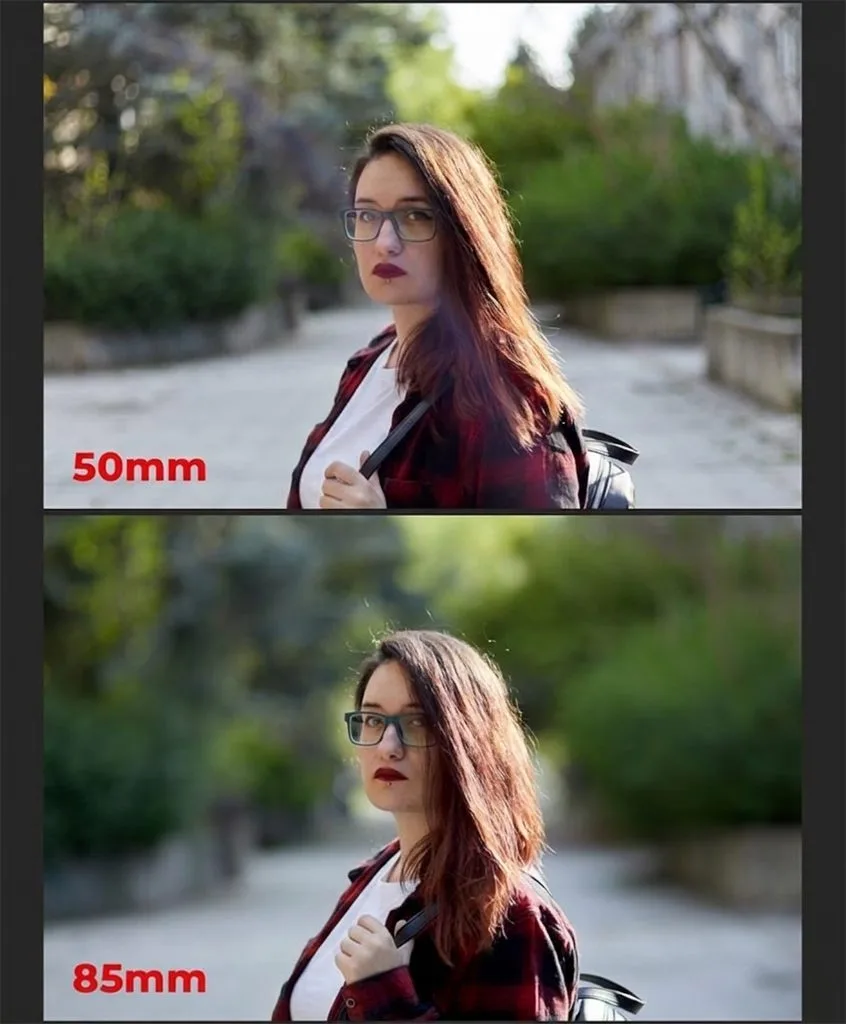
- 85mm at f/1.8 melts those same backgrounds into smooth colour and light. A messy car park or a cluttered café becomes a painterly wash.
If you regularly shoot in busy locations and can’t control your background, the 85mm is a cleanup tool you carry on your camera. If you want to blur backgrounds even more, a longer lens plus a wider aperture is the combination — but you can also simulate a softer background in editing.
The 50mm: The Storyteller’s Lens
If the 85mm is a scalpel, the 50mm is a Swiss Army knife. Here’s why it stays on so many cameras.
It Sees Like You Do
The human eye’s focused field of view is often cited as equivalent to around 40–45mm on full frame — right next to 50mm. That’s why photos taken at 50mm feel “natural.” There’s no dramatic wide-angle stretch and no telephoto compression. Viewers feel like they’re standing in the room with your subject.
This makes the 50mm the king of environmental portraits — photos where the person and their surroundings tell the story. A chef in their kitchen, an artist in their studio, a musician on a dim stage: a 50mm keeps enough context in the frame that the location becomes a character. If you’re composing with foreground and background layers, the 50mm gives you room to use both.
It Works Anywhere (Including Tight Spaces)
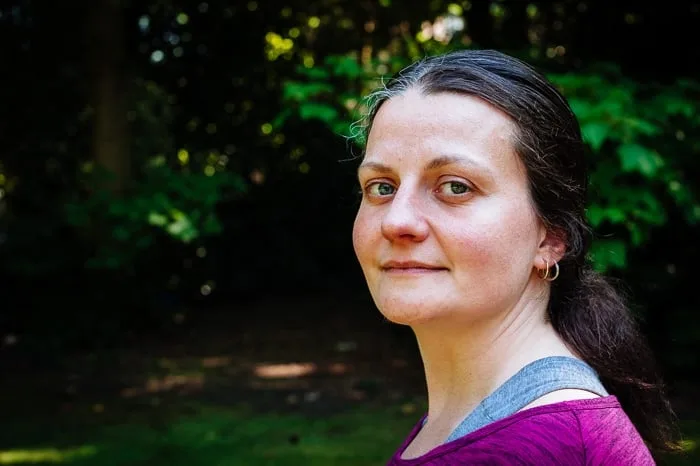
A 50mm needs half the room an 85mm does. Indoors, at parties, in small studios, on city streets where you can’t step back into traffic — the 50mm just works. You can “zoom with your feet”: two steps forward for an intimate close-up, two steps back for a full-body environmental shot.
It’s the Cheapest Fast Glass You Can Buy
A basic 50mm f/1.8 is the least expensive way to get into large-aperture photography. Canon’s EF 50mm f/1.8 “nifty fifty” weighs about 160 g and costs roughly $125–150. Sony’s FE 50mm f/1.8 is around 186 g and about $250. Compare that with a typical 85mm f/1.8 at 350–470 g and $400–600, and the 50mm is the obvious first prime for anyone on a budget. (Budget 85mm options from TTArtisan, Meike, and Viltrox have closed the gap — some autofocus 85mm f/1.8 models now start around $100–200 — but the 50mm still wins on size and weight.)
It’s a Wedding and Event Workhorse
Most wedding photographers carry a 50mm for getting-ready rooms, receptions, and dance floors — places where an 85mm would be too long. It’s wide enough for groups, fast enough for low light, and close enough that you can direct your subject in a normal speaking voice.
The 85mm: The Portrait Specialist
If your goal is “make one person look incredible and make everything else disappear,” the 85mm was basically invented for you. Sony calls it “the gold standard for portraiture,” and most working headshot and fashion photographers agree.
Flattering by Default
As we covered, the 85mm’s working distance keeps facial proportions natural. You can shoot tight headshots without worrying about big-nose distortion, and the slight compression slims the jawline and softens skin texture in a way clients consistently prefer.
Backgrounds Vanish
At f/1.8 or wider, an 85mm turns almost any background into abstract colour. A chain-link fence, a busy street, a cluttered living room — none of it survives an 85mm wide open. That’s why it’s the go-to lens when you can’t control your location but need a clean, professional-looking portrait.
It Slows You Down (In a Good Way)
Several working photographers note that the 85mm’s longer reach forces you to be more deliberate. You can’t just snap and move; you compose more carefully, you wait for the right expression, and you end up with fewer but stronger frames. Wedding photographers often hand the 85mm to a second shooter because it lets them capture candid moments from across the room without being in anyone’s face.
The Trade-Offs
It’s not all perfect. The 85mm:
- Needs space — useless in very small rooms.
- Is heavier and pricier than a 50mm.
- Has a longer minimum focus distance (typically ~0.8 m vs ~0.4 m for a 50mm), so you can’t focus as close for detail shots.
- Can feel distant from your subject; directing a model from 3 metres away takes a louder voice and more hand signals.
The Crop-Sensor Reality: Everything Shifts
If you’re shooting on an APS-C or Micro Four Thirds camera, stop reading the full-frame advice — it doesn’t apply directly. Crop factor multiplies your effective focal length:
| Sensor | Crop factor | 50mm becomes | 85mm becomes |
|---|---|---|---|
| Full frame | 1.0x | 50mm | 85mm |
| Nikon / Sony / Fuji APS-C | 1.5x | 75mm | 128mm |
| Canon APS-C | 1.6x | 80mm | 136mm |
| Micro Four Thirds | 2.0x | 100mm | 170mm |
On a 1.5x crop body, a 50mm is already a 75mm-equivalent portrait lens — basically the classic portrait focal length. An 85mm on the same body becomes a 128mm-equivalent, which is long: great for headshots and extreme compression, but too tight for half-body shots in average rooms.
This is why the Photo StackExchange community consistently tells crop-sensor shooters: start with the 50mm. It gives you the portrait look without the cramped working distance. If you’re on MFT, even a 45mm or 42.5mm f/1.7 hits the 85mm-equivalent sweet spot.
Which One Should You Buy?
Let’s match the lens to how you actually shoot.
Choose the 50mm if…
- You shoot indoors, in small studios, or at events where space is limited.
- You want environmental portraits that show subject and location.
- This is your first prime lens and you’re on a budget.
- You shoot weddings, street, travel, or documentary work and need one versatile lens.
- You’re on a crop-sensor body and want a classic portrait length without going too long.
Choose the 85mm if…
- Headshots, beauty, fashion, and close-up portraits are your main focus.
- You regularly shoot in cluttered or uncontrolled locations and need to erase backgrounds.
- You have room to back up (studios, gardens, streets with space).
- You already own a 35mm or 50mm and want a dedicated portrait prime.
- You want maximum subject isolation and the most flattering facial rendering.
If You Can Only Own One…
For most people reading this, the 50mm is the safer one-lens choice. It does 80% of what an 85mm does (stop down slightly, step back a little, and you can get very close to the 85mm look) plus a dozen things the 85mm can’t do indoors. The 85mm is a specialist — brilliant at its job, but limiting if it’s your only lens.
That said, if you know you only shoot headshots and portraits outdoors or in a decent-sized studio, the 85mm will make you happier every single time.
Shooting Tips for Both Lenses
A few hard-earned pointers that apply whichever you pick.
- Focus on the near eye. At f/1.4–f/1.8 your depth of field can be thinner than a coin. If the near eye is sharp, viewers forgive almost anything else.
- Don’t always shoot wide open. At f/1.4, an 85mm headshot can have eyelashes sharp but ears soft. Stopping down to f/2–f/2.8 gives you a little more face in focus and often sharper results overall.
- Shoot RAW. RAW vs JPEG matters most with fast primes, because you’ll often expose for the subject and recover blown highlights or lifted shadows in post.
- Mind your ISO. Indoors with a fast prime, you can keep ISO in photography low, but don’t be afraid to raise it — a slightly noisy sharp photo beats a blurry one.
- Direct at conversation volume. With an 85mm you’re far away; speak up or use hand signals so your subject doesn’t feel ignored.
- In post, keep skin natural. Whether you smooth skin yourself or send files out for portrait retouching, the lens does the heavy lifting — editing should enhance, not rescue.
Frequently Asked Questions
Is 85mm better than 50mm for portraits?
For tight headshots, beauty, and fashion work, yes — the 85mm’s working distance flatters faces and its background separation is stronger. For environmental portraits, indoor work, and versatility, the 50mm is better. “Better” depends entirely on what you shoot.
Do I need both 50mm and 85mm?
If portraits are a serious part of your work, yes — most professionals carry both. The 50mm handles groups, indoors, and storytelling; the 85mm handles headshots and isolation. If you’re a hobbyist or just starting, one is enough, and I’d start with the 50mm.
Which lens is better on a crop sensor?
On APS-C (1.5x–1.6x crop), a 50mm becomes a 75–80mm equivalent — already a classic portrait length. An 85mm becomes 128–136mm, which is quite long. Crop-sensor shooters are usually happier starting with the 50mm, or a 35mm (which becomes ~50–56mm equivalent).
Is 50mm enough for headshots?
Yes, if you can keep your distance. Shoot from at least 1.5 metres and avoid stepping in for extreme close-ups, which can widen facial features. Many classic headshots have been taken on 50mm lenses.
Is f/1.8 enough, or do I need f/1.4?
For most portrait work, f/1.8 is plenty. The jump to f/1.4 gives you one extra stop of light and slightly thinner depth of field, but at f/1.4 focus accuracy becomes critical. Budget 85mm f/1.8 lenses now deliver 90% of the portrait look for a fraction of the cost.
Can I get the 85mm look with a 50mm by cropping?
Partially. Cropping a 50mm image mimics the tighter framing, but it can’t replicate the 85mm’s background magnification and compression — those come from the longer focal length and greater shooting distance. You’ll also lose resolution.
Which lens is best for wedding photography?
Working wedding photographers typically use both: a 35mm or 50mm for ceremonies, getting-ready rooms, and receptions, and an 85mm (or 70–200mm) for portraits, candid moments from a distance, and isolating details. If you can only bring one prime to a wedding, the 50mm is the safer workhorse.
Final Verdict
The 50mm vs 85mm debate only feels heated because both lenses are genuinely excellent — they just excel at different things. The 85mm is the portrait specialist: flattering faces, creamy backgrounds, deliberate shooting. The 50mm is the generalist: natural perspective, works anywhere, cheap, and on a crop sensor it’s already a portrait lens.
If you remember one thing from this whole guide, remember this: the focal length doesn’t change how a face looks — your distance does. The 85mm just makes you stand at the flattering distance by default. Choose the lens that matches the space you shoot in and the stories you want to tell. And when your budget allows, get both. You’ll never regret it.