What Is a Telephoto Lens? Definition, How It Works & When to Use One
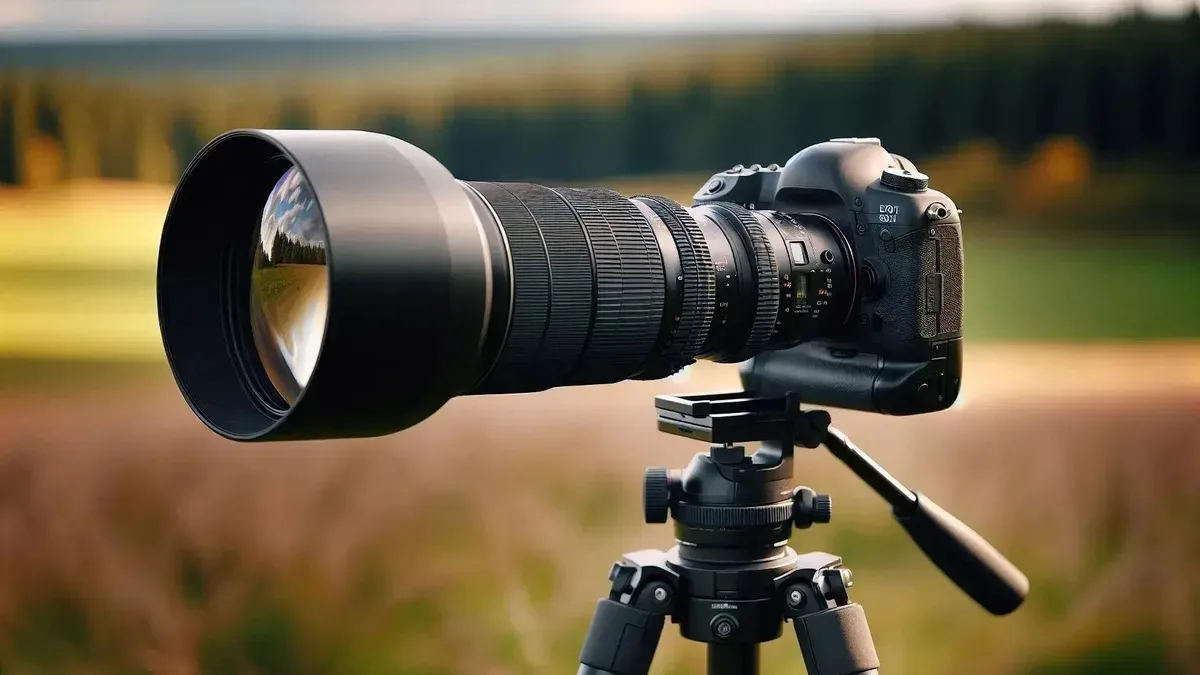
TL;DR: A telephoto lens is a long-focal-length lens (roughly 70mm and up on a full-frame camera) that makes distant subjects look close — and, strictly speaking, one built with a special “telephoto group” of lens elements so the physical barrel is shorter than its focal length. If you only remember one thing: telephoto means “far” — it brings the action to you.
You’ve seen the results. A bird filling the frame from across a lake. A quarterback frozen mid-throw from the opposite sideline. The moon looming huge behind a city skyline. That’s the telephoto lens doing its job. But if you’ve ever wondered what telephoto actually means, how it’s different from a zoom lens, or why a 200mm lens isn’t actually 200mm long, you’re in the right place. Let’s break it down.
What Is a Telephoto Lens? The Strict Definition
Let’s start with the everyday answer, then the precise one.
In casual photography talk, what is a telephoto lens? Any lens with a long focal length — one that magnifies distant subjects. The word itself tells you the telephoto meaning: tele is Greek for “far,” and photo means “light.” A telephoto lens literally brings faraway light to your sensor.
But the strict telephoto definition is a little more interesting, and it’s where most articles stop short. A true telephoto lens isn’t just “a long lens.” It’s a specific optical design.
True telephoto vs. a long-focus lens
A simple long-focus lens — a single positive element, basically a magnifying glass — would need to be physically as long as its focal length. A 400mm lens would be 400mm (about 16 inches) long, front to back. That’s unwieldy, heavy, and awkward to balance.
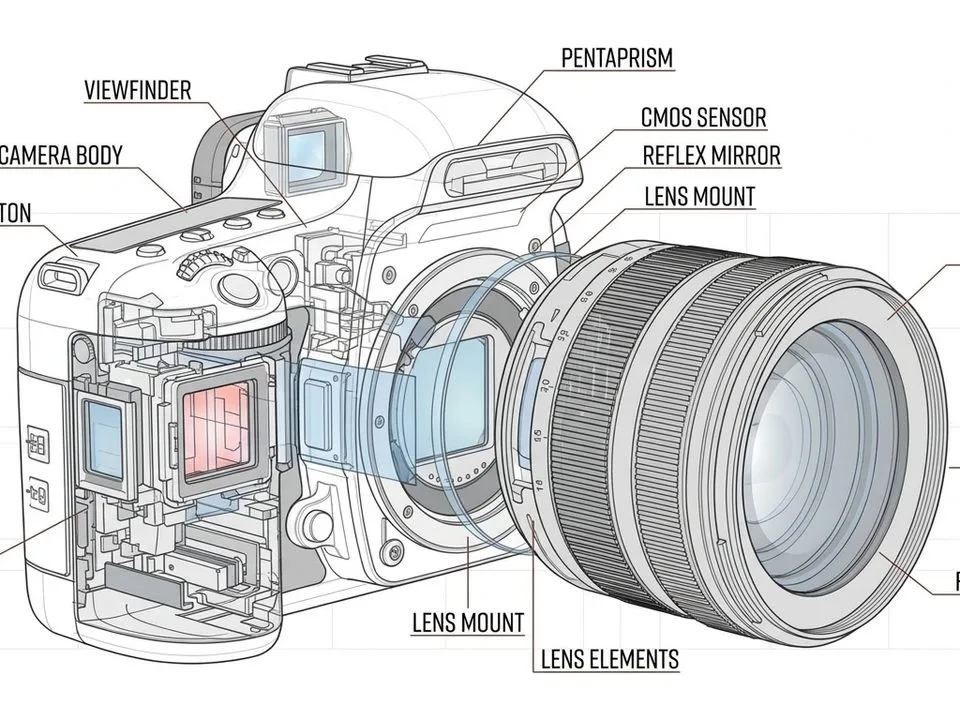
The telephoto design solves this. A true telephoto lens places a negative (diverging) “telephoto group” of elements behind the main positive front group. That rear group spreads the light back out, so the lens forms its image behind where you’d expect. The result: the optical center of the lens sits in front of the lens itself, and the physical barrel is shorter than the focal length.
Engineers describe this with the telephoto ratio — physical length divided by focal length. In a true telephoto, that ratio is less than 1. A 400mm lens might be only 250mm long. That’s the whole trick, and it’s why your 70–200mm fits in a camera bag instead of sticking out like a telescope.
The opposite design is called retrofocus — used for wide-angle lenses on SLRs so the mirror can flip up behind a short focal length. A mirror (catadioptric) lens takes the compact idea even further by folding the light path with mirrors, though it trades away aperture and smooth bokeh.
The design dates back to the 1890s — Thomas Rudolphus Dallmeyer patented the telephoto lens in 1891, building on earlier work. You can dig into the full optical history and formula on the telephoto lens Wikipedia entry if you want the engineering deep dive.
So when someone asks “what is telephoto?” the honest answer has two layers: it’s a long lens that reaches far, and — in the strict sense — it’s a lens cleverly engineered to be shorter than its focal length.
Focal Length Ranges: Short, Medium & Super Telephoto
Focal length is what sets a telephoto apart from your kit lens. Longer = more magnification = narrower angle of view. On a full-frame camera, the ranges break down like this:
| Category | Full-frame focal length | Typical use |
|---|---|---|
| Short telephoto | 70–135mm | Portraits, events, candids |
| Medium telephoto | 135–300mm | Sports, wildlife, compressed landscapes |
| Super telephoto | 300mm and up (400, 500, 600, 800mm) | Birds, distant wildlife, astro/moon |
The most popular telephoto zooms map right onto these bands. A 70–200mm covers short-to-medium, a 100–400mm or 150–600mm stretches into super-telephoto territory, and a 400mm or 600mm prime is the big white cannon you see on sports sidelines.
Crop factor: your sensor changes the math
Focal length numbers are printed on the lens, but your sensor size determines the effective reach. A smaller sensor crops the image circle, making any lens feel longer. Multiply the lens focal length by your camera’s crop factor:
| Sensor format | Crop factor | 200mm lens becomes |
|---|---|---|
| Full-frame | 1.0× | 200mm |
| APS-C (Nikon, Sony, Fuji) | 1.5× | 300mm |
| Canon APS-C | 1.6× | 320mm |
| Micro Four Thirds | 2.0× | 400mm |
| 1-inch compact | 2.7× | 540mm |
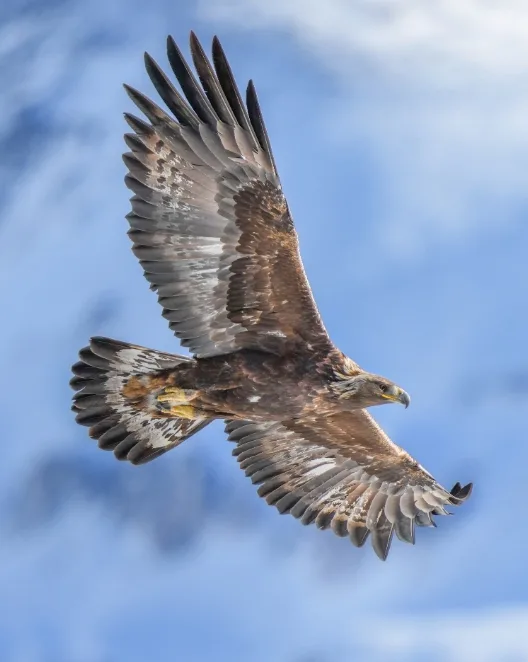
That’s why a 100–400mm on a Micro Four Thirds body behaves like a 200–800mm on full-frame — a huge, lightweight reach advantage for wildlife shooters — like the golden eagle in flight below, captured at 600mm.
If you’re on a crop-sensor body, a “short” 55–200mm kit telephoto already gives you the equivalent of roughly 82–300mm full-frame — plenty to start with.
What Does a Telephoto Lens Do? Three Effects
A telephoto does three distinct things for your photos, and it’s worth separating them.
1. Reach and magnification
The obvious one. A 400mm lens makes a subject appear roughly twice as large in the frame as a 200mm lens at the same distance. You can frame a bird on a branch, an athlete on a field, or a detail on a distant building without moving closer.
2. Perspective compression (and the big myth)
Telephotos are famous for “compression” — that look where background elements appear stacked up close behind the subject, and the moon looks giant next to a building. Here’s the twist: the lens doesn’t cause compression. Your distance to the subject does.
Think about it. To fill the frame with a subject at 200mm, you stand far away. At that distance, the gap between your subject and the background is small relative to your camera-to-subject distance — so the background looks magnified and close. At 35mm, you’d have to walk right up to the subject to fill the frame, and then the background is comparatively far away and small. Same subject size, very different background.
Even lens manufacturer Tamron explains the compression effect as a product of subject distance, not focal length alone. Frame & Focal has a great cautionary example showing that lens compression is really perspective compression.
The practical recipe: step back, then zoom in. Want that flattened, layered look? Move away from your subject and use a longer focal length to frame it. Understanding foreground vs background relationships is exactly what makes this trick work.
3. Shallow depth of field and creamy bokeh
At the same subject framing, a longer lens gives you shallower depth of field and a more magnified, creamier background. At 200mm f/2.8, the zone of sharp focus can be just a few centimeters deep — which is why portrait and wildlife shooters obsess nailing focus on the nearest eye.
Wide apertures (small f-numbers like f/2.8) amplify this: more light in, shallower focus, softer background. f/2.8 lets in twice the light of f/4 — a full stop difference. If you love that isolated-subject look, our guide on how to blur background in photos, plus this solid explainer on depth of field, will get you there. A telephoto is one of the easiest tools for it.

Telephoto vs Zoom: They’re Not the Same Thing
This is the single most common confusion. Let’s settle it with a simple grid:
| Lens | Is it telephoto? | Is it zoom? |
|---|---|---|
| 135mm f/1.8 prime | Yes (long focal length) | No (fixed length) |
| 24–70mm f/2.8 | No (not long enough) | Yes (variable length) |
| 70–200mm f/2.8 | Yes | Yes |
| 50mm f/1.8 | No | No |
Telephoto describes how long the focal length is. Zoom describes whether the focal length can change. A 70–200mm is both. A 400mm prime is telephoto but not zoom. A 24–70mm is zoom but not telephoto. Got it? Good — this alone will make you sound like you know your stuff.
Prime vs zoom telephotos
- Zoom telephotos (70–200, 100–400, 150–600) give you flexibility — one lens covers many framing situations. Modern mirrorless zooms are significantly shorter and lighter than their DSLR predecessors.
- Prime telephotos (85mm, 135mm, 300mm, 400mm) typically offer faster apertures, better optical quality per dollar, and smaller size at a given focal length — but you zoom with your feet.
A quick note on teleconverters: these 1.4× or 2× extenders fit between lens and body to multiply your reach. A 1.4× costs you one stop of light; a 2× costs two stops and visibly softens the image. Pair them only with fast, sharp lenses, and expect to sharpen an image a bit more in post.
Aperture Tradeoffs: f/2.8 vs f/4 vs Variable
Aperture is where telephoto choices get expensive and heavy. The faster the glass, the bigger the front element, and the bigger the price tag. Here’s the practical comparison:
| Aperture type | Light gathering | Typical weight (70–200mm) | Relative cost | Best for |
|---|---|---|---|---|
| Constant f/2.8 | Most (1 stop faster than f/4) | ~950g–1.5kg | Highest | Pro sports, events, low light |
| Constant f/4 | Good | ~30–40% lighter | ~40% cheaper | Daylight, travel, lightweight pros |
| Variable f/4.5–6.3 | Least (narrows as you zoom) | Lightest, most compact | Lowest | Hobbyists, wildlife on a budget |
A constant f/2.8 zoom is the pro workhorse because it stays fast at every focal length and lets you shoot in dim stadiums or wedding receptions while freezing action. An f/4 constant is the “pro’s lightweight” choice — nearly as sharp, much easier on the shoulder. A variable-aperture super-zoom like a 150–600mm gives you enormous reach for the money, but at 600mm you’ll be at f/6.3 and leaning on higher ISO settings.
For scale, a modern Sony FE 70–200mm f/2.8 GM II weighs about 950g; an older DSLR f/2.8 tele-zoom could hit 1,500g. The lens you actually carry beats the heavier one you leave at home.
What Is a Telephoto Lens Used For? Uses by Genre
Different subjects demand different reaches. Here’s a quick field guide:
| Genre | Typical focal length (full-frame) | Pro tips |
|---|---|---|
| Wildlife & birds | 400mm minimum, 600mm common | Shoot from a blind or car; use animal-eye AF; 1/1000s+ for birds in flight |
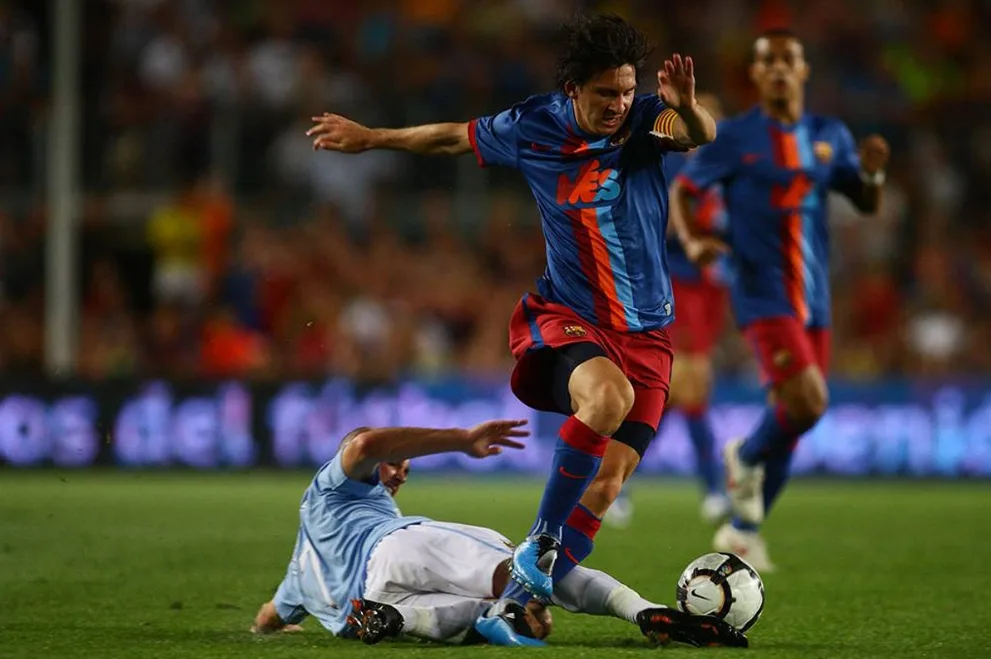
| Sports & action | 70–200mm near sideline, 100–400mm far field | Monopod for mobility; raise ISO indoors; pan at 1/60–1/250s |
| Portraits | 85–135mm sweet spot | 85mm natural, 105mm classic, 135mm strong compression, 200mm+ dramatic |
| Landscape & cityscape | 100–200mm | Stack layers, compress skylines, make sun/moon huge behind landmarks |
| Astro & moon | 300mm+, 400–600mm better | Tripod, magnified manual focus on craters; try the Looney 11 rule |
| Events & candids | 70–200mm f/2.8 | Work unobtrusively from across the room |
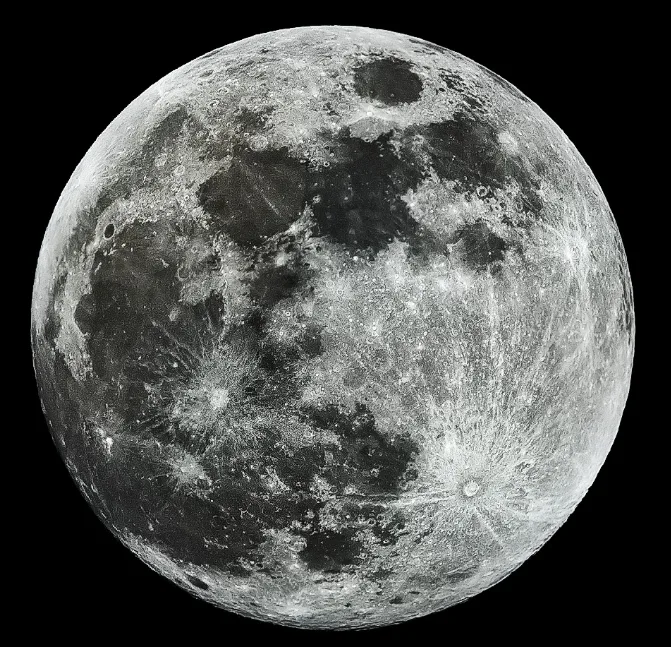
For moon shots, the classic Looney 11 exposure is f/11, ISO 100, shutter speed around 1/100s — but at 400mm+ you’ll want a faster shutter (1/320s or more) and a higher ISO to avoid shake. If the moon won’t fill the frame enough, shoot a sequence and create a panorama to stitch in high resolution.
Smartphone Telephoto & Periscope Zoom
Your pocket camera has a telephoto too — and it’s worth understanding what’s real and what’s marketing.
- Optical zoom: physical lens elements magnify the light before it hits the sensor, so full resolution is preserved. Most phone “telephoto” cameras are 2×–3.2× (about 50–75mm equivalent).
- Periscope (folded optics): a prism bends light 90° so a longer lens can lie horizontally inside the phone. This achieves true 3×–10× optical zoom (roughly 120–240mm+ equivalent). You’ll see it called tetraprism on iPhones or periscope on Samsung Galaxy Ultra models. TechTweak explains periscope zoom clearly, and SamMobile breaks down phone zoom types.
- Digital zoom: the camera crops the image and upscales it in software. Detail is lost — it’s the same as cropping in post and trying to resize image files back up. That “100× space zoom” headline? Mostly digital and AI beyond the optical range.
- Hybrid zoom: combines optical, sensor-crop, and AI upscaling. Better than pure digital, not as good as true optical.
One marketing gotcha: zoom ratios are often measured from the ultrawide lens, not the main camera. A “10×” phone might only be 5× from its main sensor. The real value of a phone telephoto isn’t just reach — it’s flattering portrait compression and genuine optical bokeh, instead of computational fake-blur.
Keeping Telephoto Shots Sharp: Stabilization & Shutter Speed
Long lenses magnify everything — including your handshake. The classic rule of thumb is the reciprocal rule: your minimum handheld shutter speed should be roughly 1 divided by your effective focal length. So 200mm on full-frame = at least 1/200s (round up to 1/250s). PhotoWorkout covers the shutter speed math and crop-factor details in depth.
And yes — crop factor applies here too. That same 200mm on a 1.5× APS-C body behaves like 300mm, so you need 1/300s or faster:
| Body | 200mm effective | Minimum handheld shutter |
|---|---|---|
| Full-frame | 200mm | 1/200s (use 1/250s) |
| APS-C 1.5× | 300mm | 1/300s |
| Canon APS-C 1.6× | 320mm | 1/320s |
| Micro Four Thirds 2× | 400mm | 1/400s |
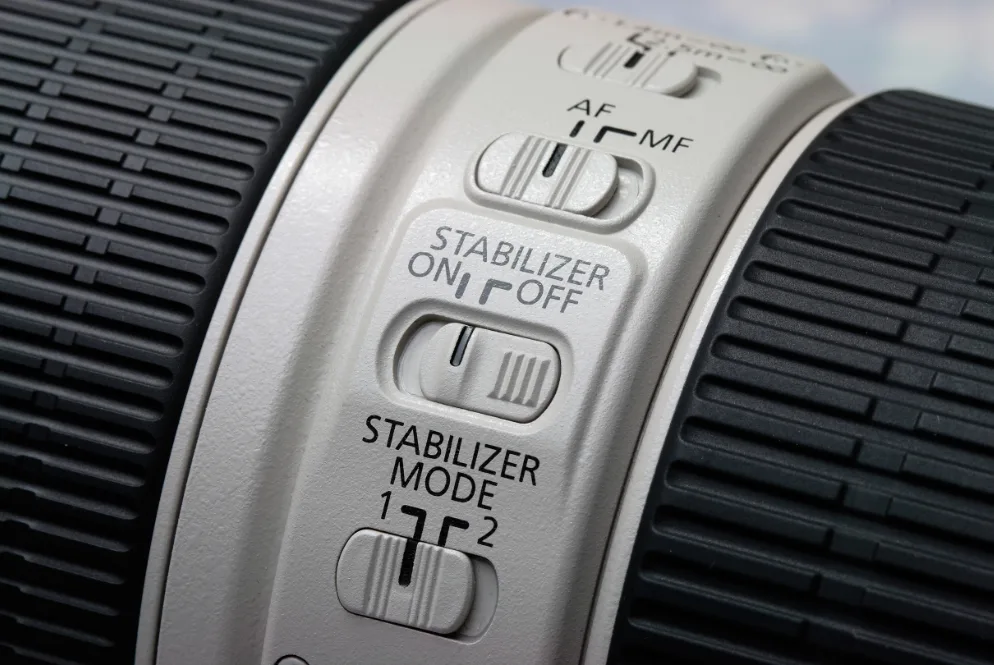
Image stabilization (IS, VR, OSS, or in-body IBIS) buys you roughly 2–4 stops of hand-holdability (manufacturers claim up to 8; count on less). Critical caveat: stabilization counters camera shake, not subject motion. A running athlete still needs 1/500s–1/1000s, IS or no IS. If your shots are still soft, our guide to fixing motion blur walks through the fixes.
Two more sharpness notes: high-megapixel sensors (40MP+) reveal tiny shake, so double your shutter speed. And on a locked tripod with an older lens, turn stabilization off — it can hunt and actually introduce blur.
Common Myths About Telephoto Lenses, Busted
- “Telephoto means zoom.” No. See the grid above. Telephoto = long; zoom = variable.
- “A 200mm lens is 200mm long.” No — the telephoto group makes it shorter. That’s the entire point of the design.
- “Longer focal length = more megapixels or sharper.” No. Focal length changes framing and magnification, not resolution. A slow telephoto shot at high ISO can be softer than a well-shot wide angle cropped.
- “100× phone zoom equals a telescope.” No — beyond the optical/periscope range it’s digital crop and AI.
- “Image stabilization freezes action.” No — it only steadies your hands.
- “You always need a tripod.” Not at moderate lengths with modern IS, but 300mm+ really benefits from a monopod or tripod — and good technique (elbows in, brace against something).
When NOT to Use a Telephoto Lens
A telephoto is a specialist tool, not always the right one. Skip it when:
- You’re in a tight room and can’t step back — you’ll never get the whole scene.
- You want environmental context around your subject — a wide lens tells more story.
- You’re shooting intimate, close-up candids where being near your subject matters.
- You need deep depth of field for a group or landscape — long lenses make it hard to get everything sharp.
- Midday heat shimmer is distorting distant subjects — shoot in cool mornings or evenings instead.
- Weight and cost matter more than reach. Be honest about what you’ll carry.
How to Choose Your First Telephoto Lens
Start by matching the lens to what you actually shoot, not the specs that look impressive.
- Budget ($250–$550): A 55–210mm, 70–300mm, or used 70–200mm f/4–5.6 gets you reach without breaking the bank. Great for learning.
- Mid-range ($700–$1,200): A 70–200mm f/4 constant, a 100–400mm, or a third-party 150–500mm gives you serious reach and solid build quality.
- Pro tier ($1,800+): A 70–200mm f/2.8 or a 400mm+ prime — for working sports, wildlife, or event photographers.
Quick decision checklist: What’s your main subject? Do you shoot in low light? How much weight will you carry? Do you have a crop-sensor body (free reach)? Answer those and the right lens usually reveals itself.
When you shoot, use RAW vs JPEG — RAW gives you far more room to recover shadows and fix noise from the high ISOs telephotos often demand. Those big RAW files add up fast, so plan your cloud storage and backups before a big trip.
Care & Handling Tips
A telephoto is an investment — treat it right:
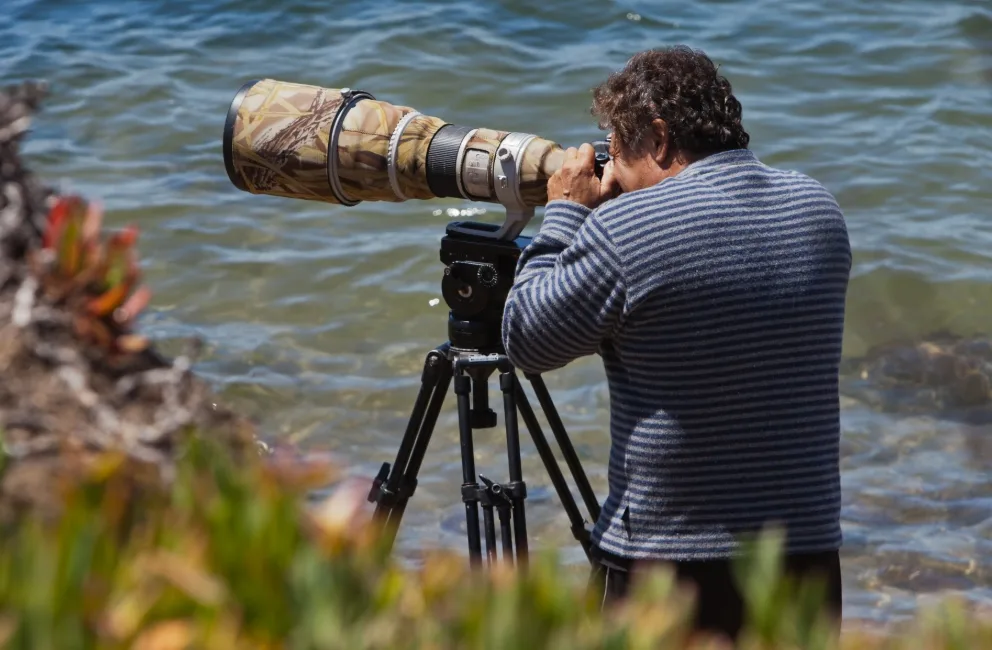
- Tripod collar/foot: mount the lens, not the camera body, to your tripod. It balances the weight and protects your lens mount.
- Lens hood: always use it — it cuts flare and shields the front element from bumps. It reverse-stores on the lens when not in use.
- Never point at the sun: a telephoto concentrates sunlight like a magnifying glass and can burn your shutter, sensor, or your eye. Cap it when not shooting.
- Filters: large front elements (77–95mm) mean expensive filters. A UV or clear protector is worth it; big pro lenses often use drop-in slot filters instead.
- Support technique: cradle the lens with your left hand, elbows in. For sports, a monopod is more practical than a tripod.
Conclusion
So, what is a telephoto lens? It’s your ticket to the action you can’t walk up to — a long, cleverly engineered lens that pulls the distant world close, flattens backgrounds into dreamy layers, and melts backgrounds into butter. Whether you go for a compact 70–200mm, a monster 600mm prime, or just the periscope lens in your pocket, the same rules apply: mind your shutter speed, step back to compress, and carry the lens you’ll actually use. Now go make the faraway feel near.
Frequently Asked Questions
What is a telephoto lens?
A telephoto lens is a long-focal-length lens (about 70mm+ on full-frame) that magnifies distant subjects. In the strict optical sense, it’s also a lens built with a rear “telephoto group” so its physical length is shorter than its focal length.
What does telephoto mean?
The word breaks down to tele (far) + photo (light) — literally, a lens that brings faraway light to your camera. In everyday use it means any long, magnifying lens.
Is a telephoto lens the same as zoom?
No. Telephoto refers to a long focal length; zoom means the focal length is variable. A 70–200mm is both, a 400mm prime is telephoto only, and a 24–70mm is zoom only.
Is 70–300mm a telephoto lens?
Yes — 70–300mm is a telephoto zoom, covering short-to-medium telephoto range on full-frame. On a crop body it reaches even farther.
Do I need image stabilization on a telephoto?
It helps a lot for handheld shooting, buying you several stops of slower shutter. But it doesn’t freeze moving subjects — you still need a fast shutter for action.
Why are my telephoto photos blurry?
Most often: shutter speed too slow for the focal length, focus missed, or heat shimmer. Use the reciprocal rule (with crop factor), focus on the nearest eye, and shoot in cooler air.
Is a phone periscope camera a “true” telephoto?
Yes — within its optical range. A periscope lens bends light with a prism to fit a genuinely long optical path inside a thin phone. Beyond that range, zoom becomes digital or hybrid.
Why are telephoto lenses so expensive?
Long focal lengths demand large, precisely ground glass elements, complex stabilization, and rugged builds. Fast apertures (f/2.8, f/4) multiply the size and cost — that’s the price of gathering lots of light from far away.