When Was the First Camera Invented? The Real Answer (It’s Not One Year)
The Short Answer (If You’re in a Hurry)
In fact, there is no single “first camera” date — and that’s not a cop-out. It’s the honest answer. Four different years each mark a real milestone, and depending on what you mean by “camera,” any of them could be right:
- 1685 — Johann Zahn designs the first handheld reflex camera. Nobody can actually build it for 150 years.
- 1816 — Joseph Nicéphore Niépce builds the first device that captures a (fading) image on light-sensitive paper.
- 1826 — Niépce takes the oldest surviving permanent photograph, View from the Window at Le Gras.
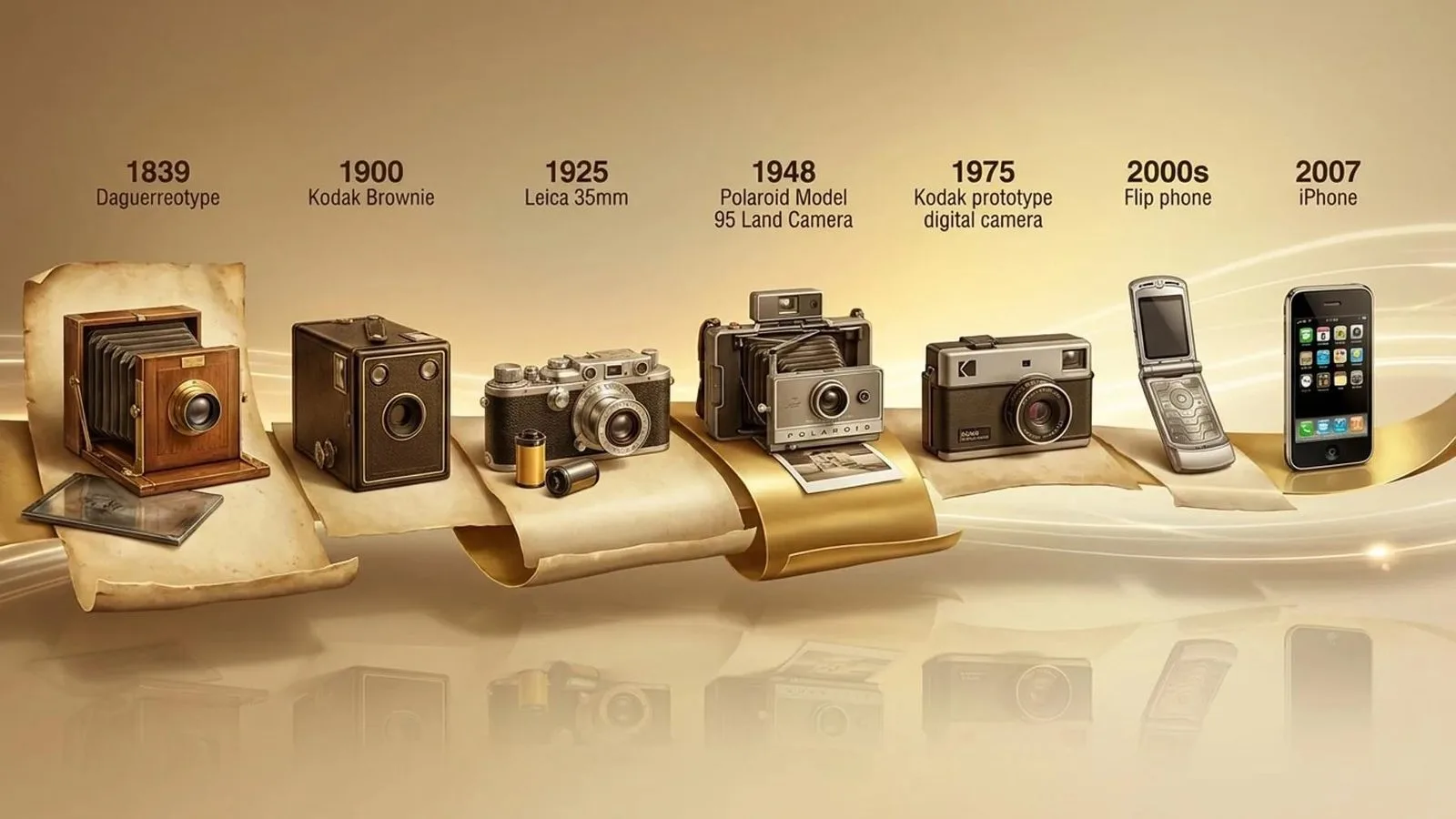
- 1839 — Louis Daguerre’s daguerreotype goes public, the French government gives it away for free, and the photography industry is born.
Most historians land on 1816 as the invention of the camera and 1826 as the first surviving photo. But if you ask “when did the camera become something real people could use?” that’s 1839. This is the full story — and it’s weirder and more interesting than any single date.
Before There Was a Camera, There Was a Dark Room
The story doesn’t start with a photographer. It starts with philosophers noticing something odd about light.
Around 400 BC, a Chinese scholar named Mozi wrote down the first known description of what we now call the camera obscura — Latin for “dark room.” He noticed that light passing through a tiny hole in a dark chamber projected an upside-down image of the outside world onto the opposite wall. Aristotle described the same thing a century later, using it to safely watch solar eclipses without staring at the sun.
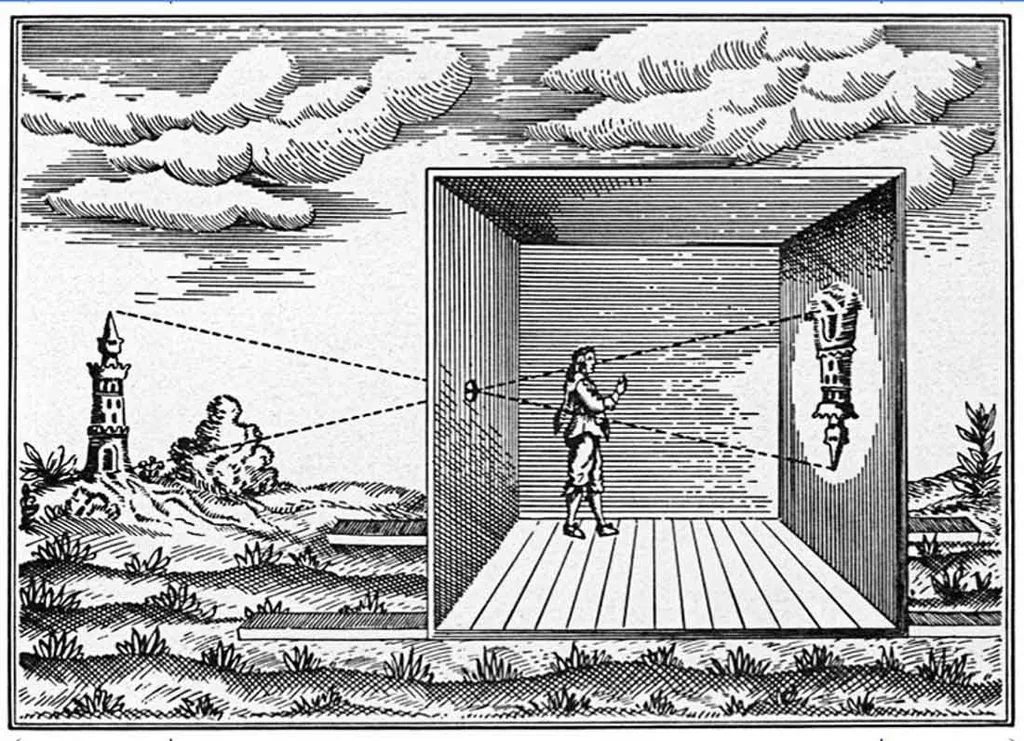
Meanwhile, for over a thousand years, that’s all it was — a curiosity. Arab scholar Ibn al-Haytham (945–1040 AD) ran real experiments with it, explaining why the image flipped and how the size of the hole affected sharpness. Leonardo da Vinci sketched over 270 versions of it in his notebooks, comparing it directly to the human eye. By the 1500s, artists were using portable tent versions of it as drawing aids — they’d trace the projected image onto canvas.
Here’s the catch, though. The camera obscura showed you an image. It couldn’t keep it. Every time you opened the door, the projection vanished. What was missing was a material that would react to light and hold the image permanently. That invention would take another 200 years.
In 1725, a German professor named Johann Heinrich Schulze discovered that silver salts turned black when exposed to light. He had found the chemistry. Nobody put the chemistry and the dark room together for almost another century.
Then, in 1685—yes, before scientists even understood the chemistry—a German monk named Johann Zahn designed a handheld reflex camera that looked remarkably like a modern SLR. He envisioned the device 150 years before technology could actually build it. Most historians give him co-credit for inventing the camera, because he conceived of it as a portable, usable device rather than a room-sized curiosity.
Niépce and the First Photo That Survived
A French inventor named Joseph Nicéphore Niépce finally put all the pieces together. He wasn’t a photographer—photography didn’t exist as a profession yet. Instead, he worked as a gentleman experimenter with a background in engraving, driven by an obsession to find a way to copy images without drawing them by hand.
Starting around 1816, Niépce built a small wooden box with a lens — essentially a portable camera obscura — and placed paper coated with silver chloride inside it. It worked. Sort of. The image appeared, but it faded quickly because he had no way to “fix” it (stop the chemical reaction). He wrote to his brother about it, and those letters are the main reason we know he got there first.
Instead of giving up, Niépce continued experimenting. He switched to a weird material called Bitumen of Judea — a naturally occurring asphalt that hardens when exposed to sunlight. He coated a pewter plate with it, slid it into his box camera, and pointed it out the window of his family estate in Burgundy, France. The exposure took roughly eight hours (some sources say several days). When he washed the plate with lavender oil and white petroleum, the unexposed bitumen dissolved away, leaving a permanent image.
Niépce captured that image in 1826 or 1827 and named it View from the Window at Le Gras. It’s grainy, it’s faint, and you can barely make out rooftops and a tree. It is also the oldest surviving photograph in the world. It sits today in the Harry Ransom Center at the University of Texas at Austin.
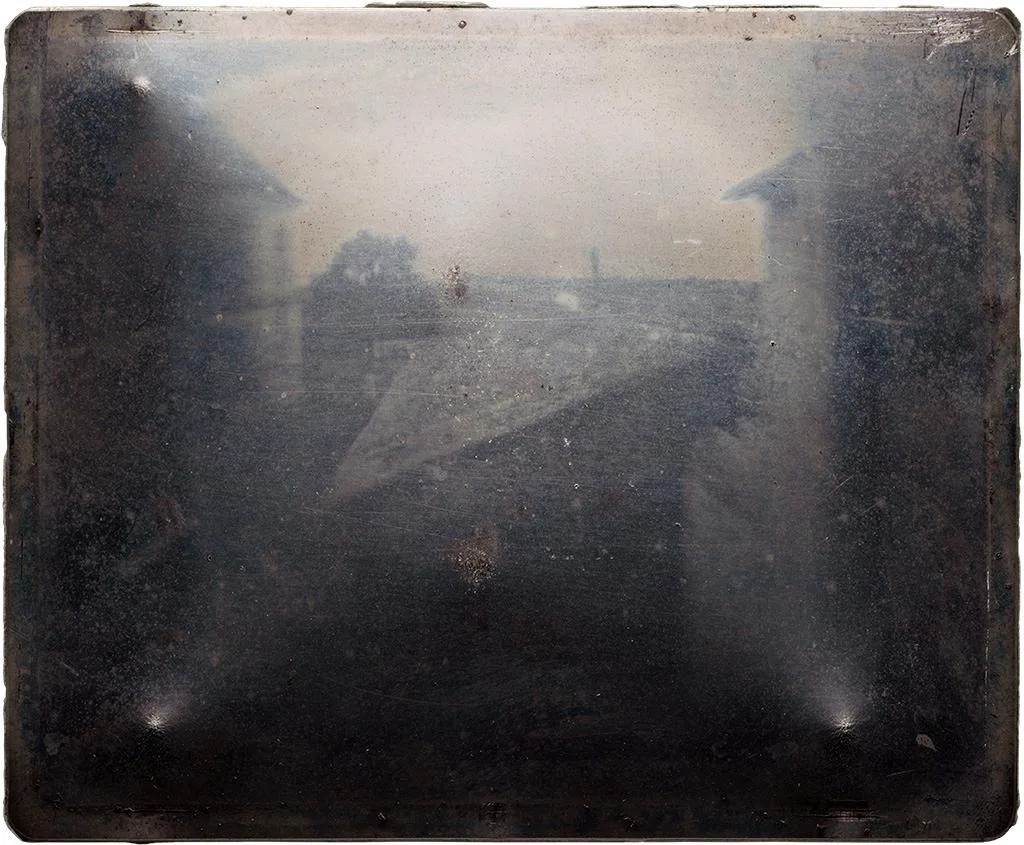
Niépce called his process heliography — sun drawing. It was the first time in human history that light had permanently recorded itself. The exposure was so long that the sun moved across the sky during the shot, lighting both sides of the buildings — something you’d never see in a real photo.
In 1829, Niépce partnered with a stage designer and painter named Louis Daguerre, who was chasing the same goal. Niépce died in 1833, leaving his notes to Daguerre, who kept experimenting and eventually changed the process entirely.
1839: The Year Photography Exploded
However, if 1826 was the birth, 1839 was the coming-out party. It’s the single most important year in camera history.
Daguerre had discovered that a silver-plated copper sheet, sensitized with iodine fumes, exposed in a camera, and then developed with mercury vapor produced a sharp, detailed image in minutes instead of hours. He called it the daguerreotype. The French government bought the patent from him (in exchange for a lifetime pension for Daguerre and Niépce’s son) and gave it away to the world as a “free gift.”On August 19, 1839, the French government publicly announced the process in Paris. Photography went from a secret experiment to a global phenomenon almost overnight.
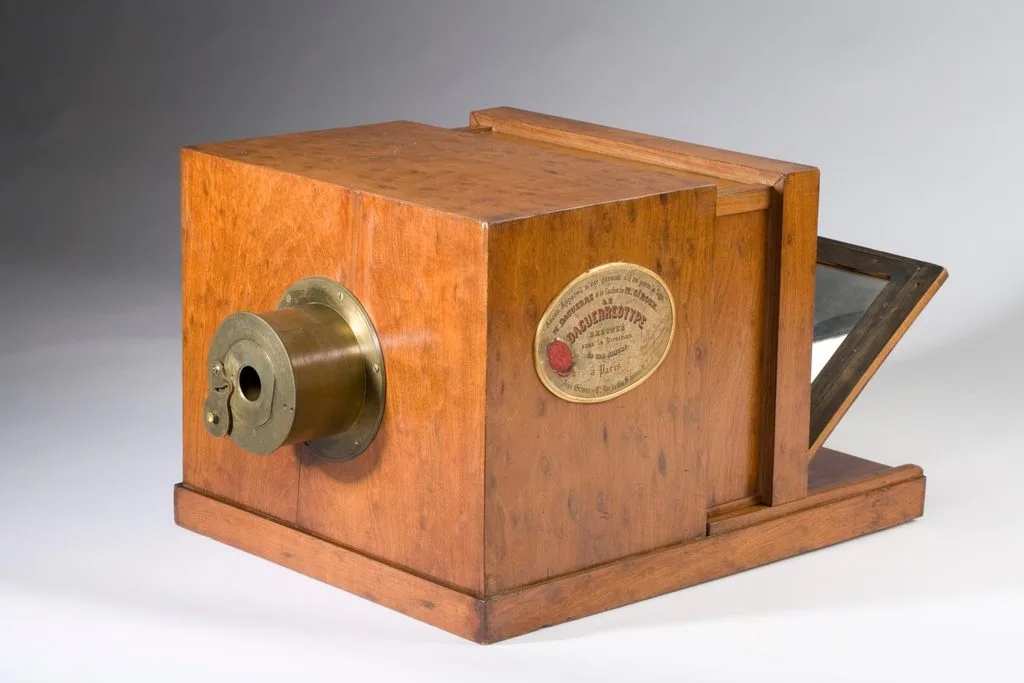
That same year, Alphonse Giroux — Daguerre’s brother-in-law — started selling the first commercially produced camera, a wooden box with standardized plates. It cost about 400 francs, roughly $7,000 in today’s money. Not cheap, but you could actually buy one.
Also in 1839, across the English Channel, William Henry Fox Talbot presented his own process to the Royal Society. He used paper coated with silver salts and produced a negative — meaning you could make multiple prints from one exposure. He called it the calotype (patented in 1841). It was blurrier than the daguerreotype, but the negative-to-positive principle is the foundation of every film camera that followed.
And in America, Alexander Wolcott patented a mirror camera in 1839 that used a concave mirror instead of a lens. It cut portrait exposure time from 30 minutes to 5, and in 1840 he and his partner opened the world’s first commercial portrait studio in New York City. For the first time, ordinary people could have their likeness captured — if they could sit perfectly still for five minutes.
A side note: Sir John Herschel, another Victorian polymath, figured out how to fix images permanently with hypo (sodium thiosulfate) in 1839, coined the word “photography,” and invented the cyanotype process (the blueprint). 1839 was a very busy year.
From Wet Plates to Dry Plates: Speed Is Everything
Despite its advantages, the daguerreotype had two big problems. Each image was one-of-a-kind (no negative), and the chemicals were nasty — mercury vapor is toxic. The next breakthroughs were all about making photography faster, cheaper, and reproducible.
In 1851, English sculptor Frederick Scott Archer invented the wet collodion process, which used glass plates coated with a syrupy chemical that photographers had to expose and develop while still wet. It was cheap, sharp, and produced negatives, but you had to carry a portable darkroom with you everywhere. Photographers literally hauled tents and chemicals into battlefields during the Crimean War and the American Civil War. It dominated for 25 years.
Then, in 1871, an English doctor named Richard Leach Maddox — who was sick of breathing chemical fumes — invented the gelatin dry plate. You could buy them pre-made, store them, and develop them later. No portable darkroom needed. By 1878, Charles Harper Bennett had improved them to the point where exposure times dropped to 1/25 of a second. For the first time, you could photograph moving subjects. The candid photograph was born.
Kodak: Photography for Normal People
The man who turned photography from a professional trade into a hobby was George Eastman, a bank clerk from Rochester, New York. In 1888, he released a camera called the Kodak. George Eastman designed it as a simple wooden box and preloaded it with a roll of paper film that could capture 100 shots. You took your photos, mailed the entire camera back to Rochester, and they developed it, printed your photos, and sent everything back. The slogan: “You press the button, we do the rest.”
It cost $25 (about $800 today). Expensive, but within reach of the middle class. Then, in 1900, Eastman released the Kodak Brownie — a cardboard box camera that cost one dollar. It sold over a quarter of a million units in its first run. Suddenly, kids could take photos. Families documented vacations and birthdays. Photography stopped being something only professionals did.
Eastman switched from paper film to celluloid in 1889 (after a patent fight with Reverend Hannibal Goodwin, who invented transparent flexible film in 1887). Celluloid film laid the foundation for every motion picture film stock that followed. Without it, there is no Hollywood.
35mm and the Camera That Fits in Your Coat
By the early 1900s, cameras were still pretty bulky. Fortunately, a German engineer named Oskar Barnack changed that, who worked at the Leitz company (later Leica). Barnack had asthma and hated hauling big cameras into the mountains. Around 1913, he built a prototype that used 35mm movie film — then used only for cinema — in a still camera small enough to fit in a pocket.
The Leica I went on sale in 1925. Compact and beautifully crafted, it captured 36 exposures on a standard film cassette. Photojournalists quickly embraced the camera. Henri Cartier-Bresson used one to invent street photography. War correspondents carried them into World War II. Kodak standardized the 35mm cassette as 135 film in 1934, and every camera maker could build for it. The 35mm era lasted nearly 80 years.
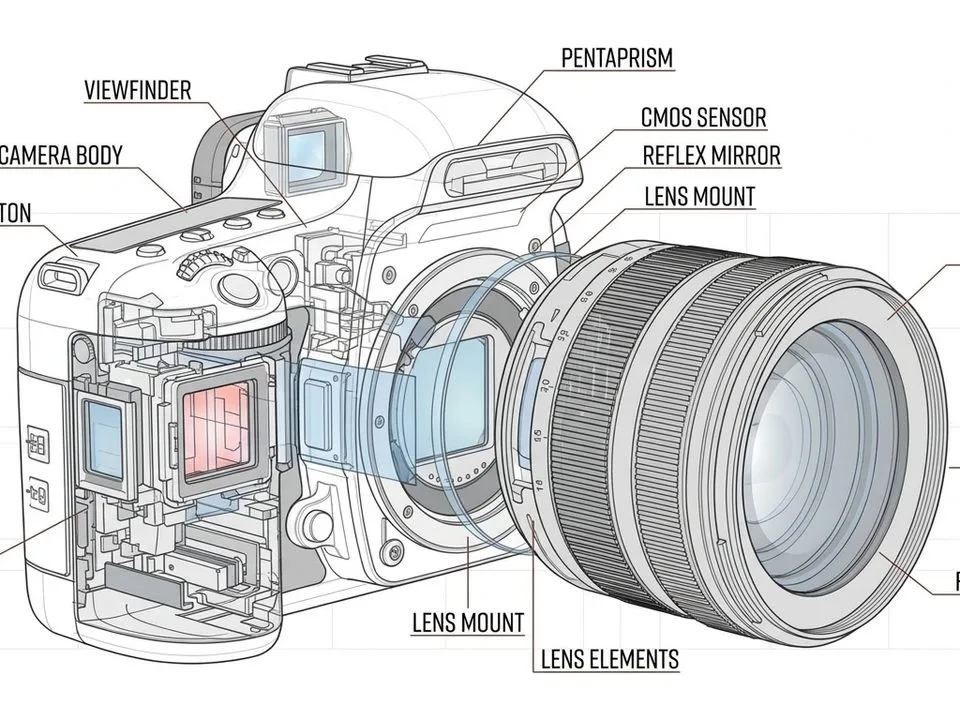
The single-lens reflex (SLR) design — where a mirror lets you see exactly what the lens sees — was first built by Thomas Sutton in 1861, but it was too complicated and expensive to mass-produce. That changed after WWII. The Rectaflex (1948) and Zeiss Contax S (1949) brought the pentaprism SLR to market, and by the 1960s the SLR was the dominant professional camera.
Color and Instant Gratification
People wanted color from day one. The first practical color process was the Lumière brothers’ Autochrome (1907), which used tiny dyed potato starch grains on a glass plate. It was beautiful but slow and expensive. Color as we know it arrived with Kodachrome in 1935, invented by two professional musicians (Leopold Mannes and Leopold Godowsky) who moonlighted as chemists. Agfacolor followed in 1936, and Kodacolor (the first color negative film for amateurs) in 1942.
Meanwhile, instant photography introduced a completely different experience. Edwin Land founded Polaroid and released the Land Camera Model 95 in 1948 — a camera that produced a finished print in under a minute. It was an instant hit (pun intended). Ansel Adams used Polaroids as test shots. Andy Warhol used them as art. By the 1960s, instant color film was available, and the iconic rainbow-striped Polaroid OneStep became one of the most recognizable cameras ever made.
The Digital Revolution (and the Irony of Kodak)
Interestingly, here’s the greatest irony in camera history. The company that did more than any other to popularize photography also invented the digital camera — and then failed to capitalize on it.
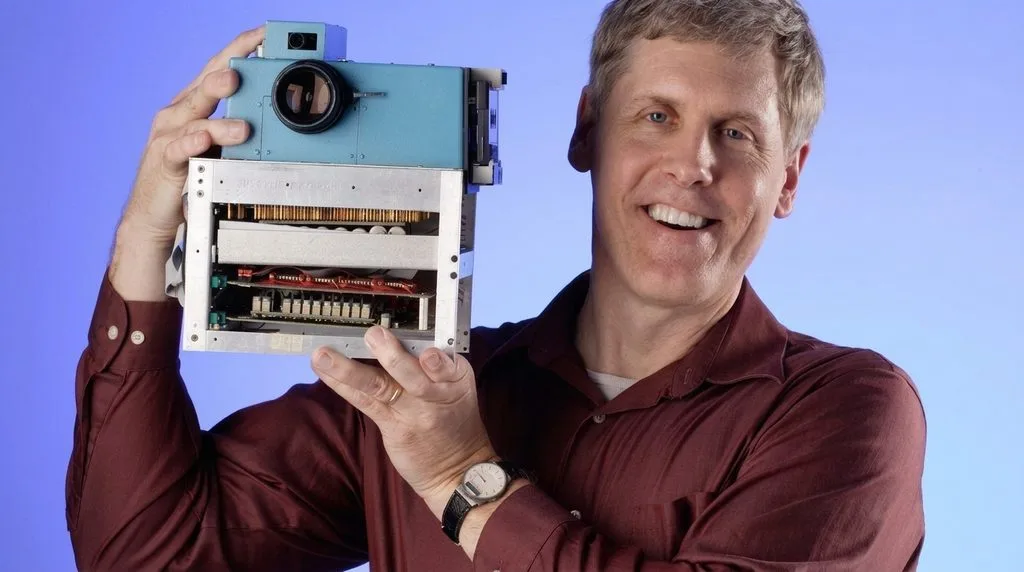
In 1975, a 25-year-old Kodak engineer named Steven Sasson built the first digital camera prototype. It weighed 8.5 pounds (about 4 kg), had a resolution of 0.01 megapixels, took 23 seconds to record a black-and-white image onto a cassette tape, and played it back on a TV screen. Kodak’s management looked at it and said, basically, “nice project — but why would anyone want to look at photos on a TV?” They buried it.
The underlying technology — the CCD sensor — had been invented at Bell Labs in 1969. Canon demonstrated the first digital electronic still camera in 1984. The first consumer digital camera you could actually buy was the Logitech Dycam Model 1 in 1990. Apple’s QuickTake followed in 1994, and the Casio QV-10 in 1995 was the first with an LCD screen on the back.
Even so, digital photography didn’t become truly professional until 1999. When Nikon released the D1 — the first professional-grade DSLR built from the ground up as digital, with a 2.7-megapixel sensor. Fujifilm’s FinePix S1 Pro (2000) brought DSLRs to consumers. By the mid-2000s, film was in steep decline. Kodak, the company that had invented digital photography, filed for bankruptcy in 2012.
Mirrorless cameras — which drop the mirror and optical viewfinder entirely, making bodies smaller and lighter — arrived with the Epson R-D1 in 2004, but it was Sony’s NEX series (2010) that made them mainstream. Today, mirrorless is the dominant professional format.
The Camera in Your Pocket
The first phone with a camera was the Kyocera VP-210 in 1999 (Japan). Sharp’s J-SH04 followed in 2000. But the real shift happened in 2007 with the first iPhone. As a result, everyone suddenly had a decent camera in their pocket. And they could share the photo instantly.
In 2024, people took roughly 1.4 trillion photos — the vast majority on smartphones. Over 90% of them were shared instantly on social media. Computational photography — AI processing that combines multiple exposures into one perfect shot — means a modern phone often produces better results in low light than a dedicated camera from 10 years ago.
If you’re shopping for a dedicated camera today, the best compact camera with viewfinder options carry forward that Leica tradition of small, quiet, pocketable tools — and the highest resolution cameras now capture 100+ megapixels, a million times more detail than Sasson’s 0.01MP prototype.
The Full Timeline at a Glance
| Year | Milestone | Who | Why It Matters |
|---|---|---|---|
| ~400 BC | First written record of camera obscura | Mozi (China) | The optical principle is identified |
| 945–1040 | Scientific study of pinhole optics | Ibn al-Haytham | Explains how the image forms |
| 1685 | First handheld reflex camera design | Johann Zahn | Conception of a portable camera |
| 1725 | Silver salts darken in light | Johann Schulze | The chemistry of photography |
| 1816 | First camera capturing (fading) images | Nicéphore Niépce | First working camera |
| 1826 | First surviving permanent photo | Niépce | View from the Window at Le Gras |
| 1839 | Daguerreotype announced; first commercial camera | Louis Daguerre / Alphonse Giroux | Photography goes public |
| 1841 | Calotype negative process | William Henry Fox Talbot | Multiple prints from one exposure |
| 1851 | Wet collodion glass plates | Frederick Scott Archer | Cheap, sharp, dominant for 25 years |
| 1871 | Gelatin dry plate | Richard Leach Maddox | No portable darkroom needed |
| 1888 | Kodak roll-film camera | George Eastman | Photography for amateurs |
| 1900 | Kodak Brownie ($1) | Eastman Kodak | Mass-market photography |
| 1907 | Autochrome color process | Lumière brothers | First practical color |
| 1925 | Leica I 35mm camera | Oskar Barnack / Leitz | Photojournalism and street photography |
| 1935 | Kodachrome color film | Mannes & Godowsky (Kodak) | Modern color photography |
| 1948 | Polaroid instant camera | Edwin Land | Prints in under a minute |
| 1969 | CCD sensor invented | Bell Labs | Foundation of digital imaging |
| 1975 | First digital camera prototype | Steven Sasson (Kodak) | Digital photography begins |
| 1990 | First consumer digital camera | Logitech Dycam | Digital hits the market |
| 1999 | Nikon D1 pro DSLR | Nikon | Digital becomes professional |
| 2007 | iPhone | Apple | The camera everyone carries |
What This Means for Your Old Photos Today
All those old cameras produced physical objects — daguerreotypes, glass plates, negatives, prints, Polaroids. They degrade over time. The chemicals fade, the paper yellows, the celluloid shrinks. If you have a shoebox of old family photos, the single best thing you can do is digitize them. A good photo scanning app can turn your phone into a decent scanner, and once they’re digital, cloud storage for photos means they’ll outlive you.
If you’re dealing with damaged or faded prints, there are also techniques to restore old photos that can bring back detail you thought was gone forever. The irony is beautiful: the oldest photographic process (Niépce’s bitumen plate) has survived nearly 200 years, while a digital photo from 2010 might already be lost if you didn’t back it up.
Frequently Asked Questions
When was the first camera invented?
The first device that captured an image (even though it faded) was built by Joseph Nicéphore Niépce around 1816. The first surviving permanent photograph dates to 1826. The first commercially sold camera appeared in 1839. Johann Zahn designed a handheld camera in 1685 but couldn’t build it. Which date you pick depends on what you mean by “invented.”
Who invented the first camera?
Most historians credit Joseph Nicéphore Niépce, because he built the first working camera that recorded an image. Johann Zahn gets co-credit for designing the first portable reflex camera 150 years earlier. Louis Daguerre made it practical, and George Eastman made it accessible to everyone.
What was the first photo ever taken?
The oldest surviving photograph is View from the Window at Le Gras, taken by Joseph Nicéphore Niépce in 1826 or 1827 at his estate in France. It required an exposure of about eight hours and is now held by the University of Texas at Austin. Niépce took earlier photos starting around 1816, but none survived.
When was the first digital camera invented?
The first digital camera prototype was built in 1975 by Steven Sasson, an engineer at Kodak. It weighed 8.5 pounds, had a 0.01-megapixel sensor, and stored images on cassette tape. The first consumer digital camera you could buy was the Logitech Dycam Model 1 in 1990.
How much did the first camera cost?
The first commercially produced camera — Alphonse Giroux’s daguerreotype camera from 1839 — cost about 400 French francs, roughly $7,000 in today’s money. The Kodak Brownie, released in 1900, cost one dollar and made photography accessible to almost everyone.
When did cameras become portable?
Johann Zahn designed a portable reflex camera in 1685, but it couldn’t be built at the time. The first truly portable cameras were daguerreotype models in the 1840s, but they still required a tripod and chemicals. The Kodak (1888) was the first handheld camera easy enough for amateurs, and the Leica I (1925) was the first that fit in a coat pocket.
What is the oldest camera ever found?
The oldest surviving physical camera is generally considered to be an 1839 Giroux daguerreotype camera. Several exist in museum collections. Niépce’s original 1826 camera doesn’t survive, but the photo he took with it does.
How did the camera change the world?
Before photography, the only visual records were drawings and paintings — subjective and slow. Photography created objective, reproducible visual evidence. It changed journalism (war photos drove public opinion), science (astronomy, medicine), art, and how families remember their own history. Today, 1.4 trillion photos are taken every year, mostly on phones.
Final Thought
The camera wasn’t invented in a single moment by a single genius. It was assembled over 2,400 years by philosophers, monks, doctors, musicians, bank clerks, and engineers. The throughline is the same human urge: to hold onto a moment before it slips away. From Niépce’s eight-hour exposure to the phone in your pocket that takes 10 photos per second, the goal hasn’t changed — only the speed.