4×6 vs 5×7 Photo Size: Which One Should You Actually Print?
TL;DR: The Short Answer
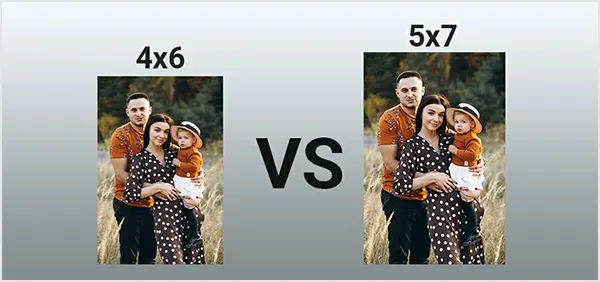
If you only remember one thing: 4×6 is the default, cheapest, album-friendly standard that matches DSLR and mirrorless cameras with zero cropping. 5×7 is 46% bigger in surface area, feels noticeably more premium in a frame, and — here is the surprise — actually crops LESS than 4×6 when you print from a smartphone. Default to 4×6 for bulk, albums, everyday snapshots, and DSLR shots; step up to 5×7 for framed gifts, portraits, gallery walls, and phone photos you want to keep intact.
At a Glance: 4×6 vs 5×7
| 4×6 (4R) | 5×7 (5R) | |
|---|---|---|
| Inches | 4 x 6 in | 5 x 7 in |
| Centimeters | 10.16 x 15.24 cm | 12.7 x 17.78 cm |
| Millimeters (lab trim) | ~102 x 152 mm | ~127 x 178 mm |
| Surface area | 24 sq in | 35 sq in |
| Aspect ratio | 3:2 (1.5) | 7:5 (1.4) |
| DSLR (3:2) crop loss | 0% | ~7% |
| Smartphone (4:3) crop loss | ~11% | ~5% |
| Typical price per print | $0.09–$0.42 | $0.84–$2.99 |
| Best for | Albums, bulk, everyday sharing | Frames, gifts, portraits, keepsakes |
Exact Dimensions: What “Bigger” Really Means
Let us get the numbers out of the way first, because “one inch bigger on each side” does not tell the whole story.
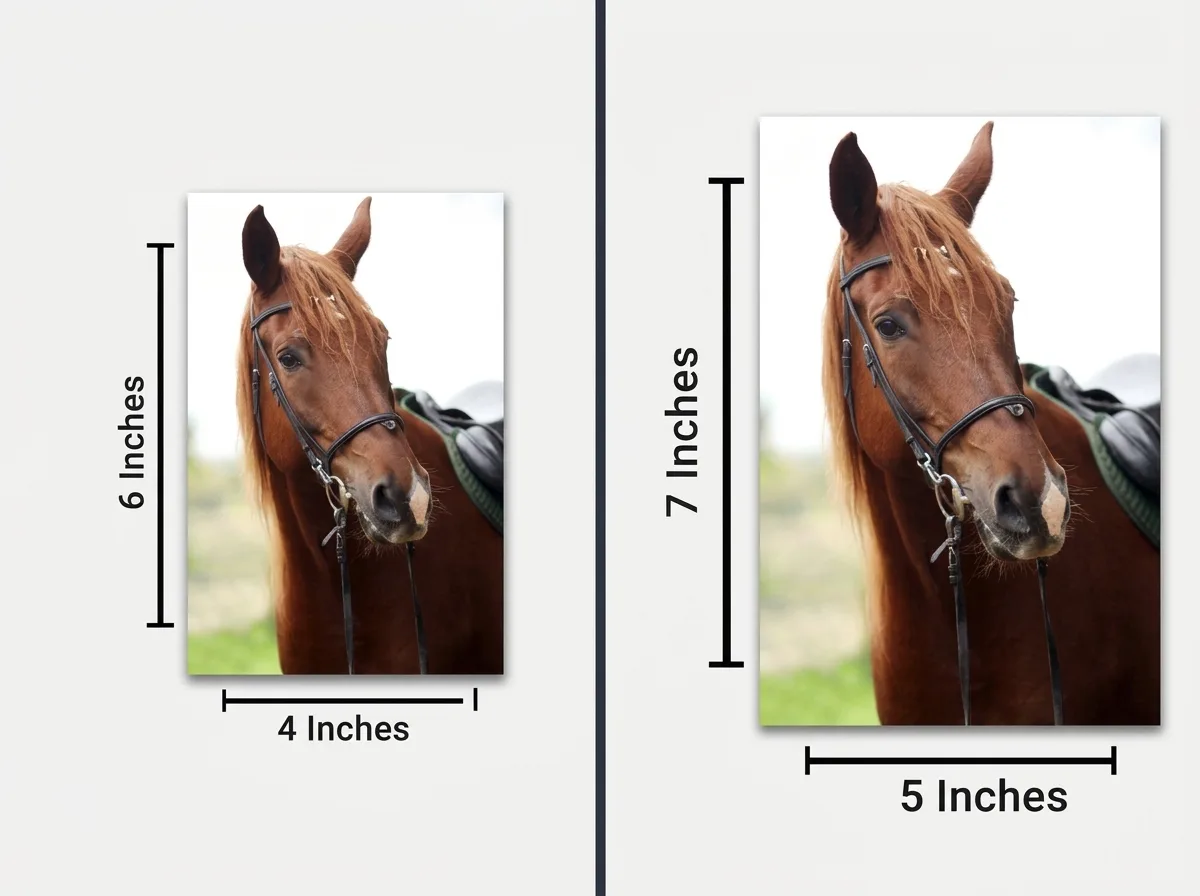
A 4×6 print measures 4 by 6 inches, or 10.16 by 15.24 centimeters. Photo labs trim it to roughly 102 by 152 millimeters, and the total surface area is 24 square inches. In the global R-series naming used by most labs, this is called 4R. In Japan it is known as KG, roughly the size of a postcard.
A 5×7 print measures 5 by 7 inches, or 12.7 by 17.78 centimeters, trimmed to about 127 by 178 millimeters. Its surface area is 35 square inches, and it carries the 5R label (2L in Japan). You can read more about how these labels map to other standard print sizes if you want the full family tree.
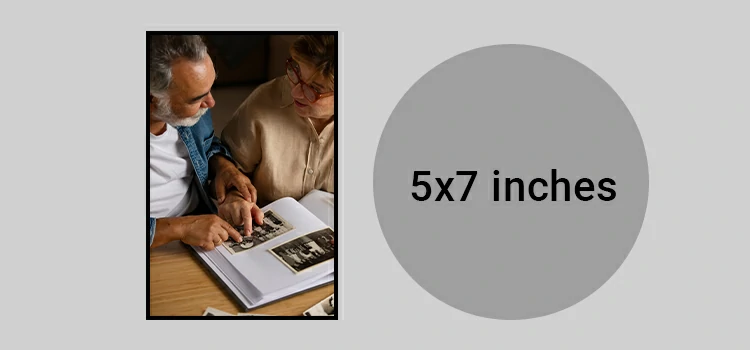
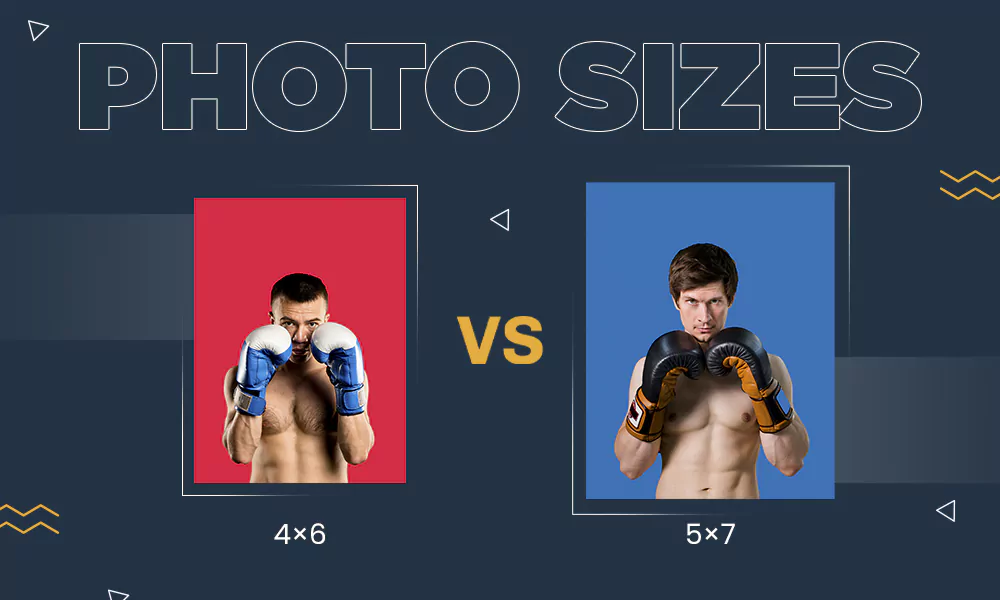
Now for the part most people underestimate. Going from 4×6 to 5×7 adds 11 square inches of paper. That is a 45.8% increase in surface area — not the 20–25% you might guess from the linear dimensions. The long side grows 16.7% (6 to 7 inches) and the short side grows 25% (4 to 5 inches). In your hand, on a desk, or on a wall, 5×7 reads as substantially larger and more substantial. It is the difference between a snapshot and a statement.
Both sizes are part of the long-standing standard photo sizes lineup, so you will never struggle to find a lab that prints either. The question is never availability — it is which one earns your specific photo.
Aspect Ratio and the Cropping Surprise
This is the section most guides get wrong, so slow down here. The shape of a print matters as much as its size, and shape is measured by aspect ratio.
A 4×6 print has a 3:2 aspect ratio (1.5). That is exactly the shape of a full-frame or APS-C DSLR and mirrorless sensor, and exactly the shape of 35mm film. If you shot it on a “real” camera, a 4×6 print requires zero cropping. What you framed is what you get.
A 5×7 print has a 7:5 aspect ratio (1.4). It matches no major camera sensor on the market. (One common mistake: some guides call 5×7 “5:4” — that ratio actually belongs to 8×10. Ignore it.) Printing a camera file to 5×7 always means either a small crop or a white border.
The Counterintuitive Part
Here is the hook that changes everything. Most smartphone cameras shoot 4:3 (1.33). Compare that to the two print shapes:
- 4×6 is 1.5 — farther from 1.33
- 5×7 is 1.4 — closer to 1.33
Because 5×7’s shape is closer to a phone’s native shape, phone photos actually lose LESS of the frame at 5×7 than at 4×6. Let that sink in: the bigger print is the less-cropped option for roughly half the photos people take today.
Crop-Loss Matrix
This table shows the percentage of your original image area that gets cut off to fit each print size, by source format:
| Source format | Native ratio | Crop to 4×6 | Crop to 5×7 |
|---|---|---|---|
| DSLR / mirrorless / 35mm film | 3:2 | 0% | ~7% |
| Smartphone (most iPhones & Android) | 4:3 | ~11% | ~5% |
| Square (Instagram, iPhone square) | 1:1 | ~33% | ~29% |
| Widescreen / cinematic | 16:9 | ~16% | ~21% |
A few takeaways from that table. DSLR shooters lose nothing at 4×6 but about 7% at 5×7 — so if you framed tightly on a face, check the edges before ordering 5×7. Phone shooters lose about twice as much at 4×6 as at 5×7, which is why your vacation snaps often look better in the larger size. Square photos get butchered at both sizes; if you love square, print square or accept a border.
If you want the deeper math on why ratios collide like this, this aspect ratio guide walks through every common format. For the broader lineup and how each one crops, our own photo print sizes guide covers the full range from wallet to poster.
Resolution, Pixels and DPI: What File You Actually Need
People panic about resolution far more than they need to. Here is the honest math.
At 300 DPI — the ideal for a print someone will hold in their hand — a 4×6 needs 1200 by 1800 pixels, or 2.16 megapixels. A 5×7 needs 1500 by 2100 pixels, or 3.15 megapixels. At the minimum acceptable floor of 150 DPI, those drop to 600 by 900 and 750 by 1050 pixels respectively.
Any camera or phone made since roughly 2005 has at least 5 megapixels, which clears both targets even after cropping. A modern 12 MP phone file could print 5×7 at well over 300 DPI. So resolution is almost never the limiting factor. If you want the full breakdown of how pixels map to physical size, our pixels and DPI explainer is worth a read, and this print resolution guide from a pro lab confirms the same targets.
What actually matters more than megapixels is which file you upload. Use the original, in-focus file from your camera roll — not the compressed copy that WhatsApp, Instagram, or email created. Messaging apps strip detail aggressively, and that softness shows up in print long before pixel count does. If you only have a low-res version, a good AI upscaler can buy you a little headroom, but it cannot invent real detail.
One hidden gotcha: borderless printing. Labs enlarge the image slightly past the paper edge so no white sliver shows. That eats another 2–3% around the perimeter. Keep faces, horizon lines, and anything important at least a few millimeters away from the edge, or ask the lab for a bordered print if your composition is tight.
When you do resize, do it the right way — upsampling carelessly can soften an otherwise sharp file. This guide on how to resize without quality loss covers the safe workflow, and our DPI for printing article tells you exactly which number to set before you hit upload.
Cost Comparison: The Real Price Gap
Size is only half the decision. Price is the other half, and the gap between these two sizes is bigger than most people realize. Prices below are per print in USD as of late 2026 and shift constantly with sales and memberships — always check the lab’s current pricing before ordering.
| Lab | 4×6 price | 5×7 price | 5×7 vs 4×6 multiple |
|---|---|---|---|
| Walmart | ~$0.09–0.18 | ~$1.09–1.47 | ~6–12x |
| Costco (members, online only) | ~$0.11–0.13 | — | — |
| Snapfish | ~$0.09–0.25 | ~$0.99 | ~4–11x |
| Shutterfly | $0.29 base (~$0.10 app) | $1.49 base (~$0.79 sale) | ~5–8x |
| Walgreens | $0.39 (1–99) / $0.29 (100+) | $2.99 | ~7.7–10x |
| CVS | ~$0.39–0.42 | ~$2.99 | ~7–8x |
| Mpix | ~$0.29–0.59 | ~$0.84–0.99 | ~1.7–2.9x |
| Nations Photo Lab | $0.59–$1.23 (by paper) | $1.95–$2.50 | ~2–3.3x |
| Printique (ex-AdoramaPix) | $1.20 | $2.25 | ~1.9x |
| Artifact Uprising (premium) | ~$2.00–2.80 | — | — |
| FreePrints app | 85 FREE 4×6/month (shipping only) | — | — |
The pattern is consistent: at the same lab, 5×7 typically costs 2.5x to 8x what 4×6 costs. The steepest markup is at drugstores like Walgreens and CVS, where 5×7 runs roughly 7–8x the 4×6 price. The smallest gap is at pro labs like Mpix, Nations Photo Lab, and Printique, where the multiple drops to roughly 1.9–3.3x. If you are printing 5×7 in quantity, a pro lab often ends up cheaper per print than a drugstore.
Two wildcards worth knowing. FreePrints gives you 85 free 4×6 prints per month and you only pay shipping, which makes 4×6 effectively free for casual users. And Shutterfly’s app pricing and frequent sales can cut 5×7 to around $0.79, narrowing the gap dramatically. This photo print sizes guide covers how their tiers and promos work.
The practical implication: for 100 vacation prints, 4×6 might cost $9–$40 while 5×7 could cost $80–$300 at the same lab. Bulk is where 4×6 runs away with it. For one or two special prints, the dollar difference is trivial and the upgrade is worth it.
Frames, Mats and Albums
Size and price matter, but so does what you put the print in. Both 4×6 and 5×7 are standard US ready-made frame sizes — you will find both at any big-box or craft store. The difference is selection and cost: 4×6 frames are more abundant and cheaper, often sold in multi-packs. 5×7 frames are a little pricier but still ubiquitous. For the full range of off-the-shelf dimensions, this list of standard frame sizes is a reliable reference.
The Mat Pairing Trick Most People Miss
Here is a fact competitors consistently leave out, and it will save you money. A 5×7 frame WITH a mat holds a 4×6 print. An 8×10 frame WITH a mat holds a 5×7 print. You do not need a frame that exactly matches your print size — the mat is what bridges the gap.
A mat window is cut roughly 0.25 inches (6 mm) smaller per side than the print so it overlaps and holds the paper flat. So a mat made for a 5×7 print has an opening of about 4.5 by 6.5 inches, and anything within 6 mm of your print’s edge hides behind the mat. That means if you order a 5×7 print for a 5×7 mat, keep important detail away from the very edge — it will be covered. You can verify these opening dimensions with any good frame mat sizes reference.
Practical move: if you already own 8×10 frames, print 5×7 and mat them. If you own 5×7 frames, print 4×6 and mat them. Buying a mat board is cheaper than buying a new frame.
Albums: 4×6 Is the Universal Standard
For albums, the verdict is almost one-sided. 4×6 is the universal pocket-album standard — the vast majority of slip-in photo albums are built around it, in every style and price range. 5×7 pocket albums exist but are a smaller niche with far less selection. 5×7 prints more commonly live in photo books or in multi-size self-adhesive albums.
So if your end goal is a traditional slip-in album, 4×6 is essentially mandatory unless you want to fight a limited market. If your end goal is a frame or a photo book, 5×7 is fully at home.
When to Choose 4×6 vs 5×7
Choose 4×6 When
- You are printing in bulk — vacation, wedding guest, or event photos where quantity matters.
- The prints go into a standard slip-in album.
- You shot on a DSLR or mirrorless camera and want zero cropping.
- You need wallet-sized sharing, postcards (4×6 fits US postcard postage), or school projects.
- You are doing scrapbooking, collages, or on-site event prints.
- You want kiosk or one-hour pickup — 4×6 is the size every kiosk stocks.
- You are making a proof or test print before committing to a larger size.
Choose 5×7 When
- It is a portrait, headshot, senior photo, or any image where the subject deserves room to breathe.
- The print will be framed on a desk, mantel, or gallery wall.
- It is a wedding, graduation, or event favor or gift — 5×7 reads as noticeably more premium.
- You are making invitations or thank-you cards and need room for text.
- You shot on a smartphone and want minimal cropping (remember the 5% vs 11% difference).
- The photo is a special keepsake where the few extra dollars are irrelevant.
Quick Decision Checklist
Run through these five questions in order. The first one that gets a strong “yes” usually settles it.
- Is this going into a standard slip-in album? If yes, 4×6.
- Am I printing more than about 20 of the same image? If yes, 4×6 (the cost gap compounds).
- Did I shoot this on a DSLR or mirrorless camera and frame it tightly? If yes, 4×6 (zero crop).
- Did I shoot this on a phone and hate cropping? If yes, 5×7 (less crop).
- Is this a gift, portrait, or framed keepsake? If yes, 5×7.
Still torn? Here is the rule of thumb that covers 90% of cases: default to 4×6 for albums, bulk, sharing, and DSLR shots; step up to 5×7 for framed gifts, portraits, special keepsakes, gallery walls, and phone photos when you want minimal cropping. And if it is genuinely a once-in-a-lifetime photo, print both. The few dollars are cheaper than regret.
Prepping Your File for Print
Before you upload anything, spend five minutes on prep. It matters more than which size you pick.
First, start from the original file. Pull it from your camera’s SD card or your phone’s full-resolution export — not from a social media or messaging app. Then crop intentionally to the print’s aspect ratio yourself, rather than letting the lab auto-crop. Auto-crop is what cuts off the top of someone’s head. If you need to do this for a whole folder at once, our guide on how to resize images in batch will save you an evening.
Second, sharpen lightly. Prints absorb detail in a way screens do not, so a file that looks crisp on your monitor can look slightly soft on paper. A gentle sharpening pass — never a heavy one — compensates. If you are reducing file size for upload, compress images carefully so you do not undo the sharpening with JPEG artifacts.
Third, mind the edges. As noted above, borderless printing over-crops by 2–3%, and mats cover roughly 6 mm per side. Treat the outer quarter-inch of your image as disposable. If it is not, order a bordered print or adjust your crop inward.
Fourth, if you are ever unsure whether your file is big enough, use our print resolution reference to check the pixel count against the print size. For 4×6 and 5×7 you will almost always clear the bar, but checking takes ten seconds and prevents a blurry disappointment.
Frequently Asked Questions
Is 5×7 bigger than 4×6?
Yes. 5×7 has 35 square inches of surface area versus 24 for 4×6 — that is 46% more paper. The long side is an inch longer (7 vs 6) and the short side is an inch longer (5 vs 4).
Which is the standard photo size?
4×6 is the default standard print size worldwide. It is what every lab, kiosk, album, and frame maker stocks first. 5×7 is also standard but is considered a step-up size, not the default.
Does 4×6 or 5×7 crop more?
It depends on your camera. DSLR and mirrorless files crop zero at 4×6 and about 7% at 5×7. Smartphone files (4:3) crop about 11% at 4×6 but only about 5% at 5×7 — so for phone photos, 5×7 crops less.
What aspect ratio is 5×7?
5×7 is 7:5, or 1.4. It does not match any major camera sensor, so it always requires a small crop or a border. (Ignore any guide that calls 5×7 “5:4” — that ratio belongs to 8×10.)
How many pixels do I need for 4×6 and 5×7 at 300 DPI?
4×6 needs 1200 x 1800 pixels (2.16 MP). 5×7 needs 1500 x 2100 pixels (3.15 MP). Any phone or camera made since about 2005 exceeds both, even after cropping.
Which is cheaper, and by how much?
4×6 is always cheaper. At the same lab, 5×7 typically costs 2.5x to 8x more per print. Drugstores have the steepest markup (about 7–8x); pro labs have the narrowest gap (about 1.9–3.3x).
Does a 4×6 photo fit in a 5×7 frame?
Yes, with a mat. A 5×7 frame with a mat is designed to hold a 4×6 print. Similarly, an 8×10 frame with a mat holds a 5×7 print. The mat window overlaps the print by about 6 mm per side.
Which size fits in a wallet or envelope?
4×6 fits standard US postcard postage and most small envelopes, and it is the size most people associate with “snapshot.” 5×7 requires a larger envelope and does not fit a wallet.
Final Take
The 4×6 vs 5×7 decision is not really about size — it is about purpose. 4×6 is the workhorse: cheap, universal, album-ready, and perfect for DSLR files. 5×7 is the showpiece: bigger, frame-friendly, gift-ready, and surprisingly gentle on smartphone photos. Let the photo’s destination decide. If it lives in an album or a shoebox, go 4×6. If it lives on someone’s wall or desk, go 5×7.
Before you send anything to the lab, give your photos a quick once-over: pull the original files, crop to the right ratio yourself, sharpen lightly, and keep important detail off the edges. If that sounds like a chore, the team at FixPhotoLab can handle the cleanup, resizing, and print prep for you — so the only decision you have to make is which size to order.